Showing posts with label fanfarlo. Show all posts

02 May 2012

SXSW 2012: Saturday


Justin Townes Earle, 1pm, Austin Convention Center Day Stage
In the interest of taking some advantage of the industry "trade show" part of the conference – in the convention center, where only really special people with badges (like me) are allowed – I rushed to try to catch an interview session with Norwegian hitmakers StarGate (the guys behind "Irreplaceable," "Firework" and about half of Rihanna's hits.) But it was cancelled. So instead I sat in on a couple of random panel sessions with assorted industry types talking about industry stuff (mobile apps, clickthrough conversions, the cloud, listening to N*SYNC in their car in high school...)

And then I wandered into a set by this Nashville songwriter guy – I'd heard the name, but don't they all have names like that? – which was phenomenal. Just, very obviously, the real deal: deft fingerpicking acoustic blues, richly gritty voice, witty poignant wryly observational songwriting, all that good stuff. Also, he has impossibly long legs. Put me in mind of Townes van Zandt (whom he reverentially quoted at one point) or a young Springsteen, but most of all Steve Earle. Come to find out, just now: Steve's his dad. Duh.


Beat Connection, 2pm, Hype Hotel
I came to Hype Hotel – magical blog-sponsored land of free vodka, free (well, for tips) chair massages and free weird, nasty Taco Bell tacos made out of Doritos (and also normal soft tacos, which I'm sheepish to report accounted for about 80% of my food intake today) – to see the super neat Canadian future-electro-pop duo New Look (one of six "New ____" artists listed in the booklet, though that's nothing next to the twelve "Young ___"s, plus three "Yung"s.) But apparently they were never even in Austin. So I got this extremely young-looking Seattle band instead. About what you'd expect from a band named after an LCD Soundsystem song, if on the sunnier end of that spectrum. Ironically, their beats were kind of disconnected – there were some issues with drummer/drum machine sync. Also their lyrics were lame. Pass.


THEESatisfaction, 2pm, Scoot Inn
Way more like it. Two-woman hip-hop tag-team (how often does that happen? does that ever happen?) and Shabazz Palaces besties, from "the top left," as they said. Similar arty/smarty vibe to Shabazz, but much less psych-addled and esoteric; way more accessible, melody-conscious, and just plain fun – hitting a tricky sweet spot between way-cooler-than-you'll-ever-be, don't-give-a-fuck detachment and casual, off-the-cuff relatability. Sweet moves (and afro) too.


Roach Gigz, 2:30pm, Scoot Inn
Before I had a chance to slip out, this hoodied San Francisco rapper dude bum-rushed the stage and commanded my absolute attention for a solid fifteen minutes (no small feat considering habitually ADD-prone SXSW mentality.) I don't think I've ever seen a rapper so dynamic in a literal, physically, kinetic sense – he didn't stop moving for an instant. And his constant, pro forma appeals for attention/energy/love from the crowd felt unusually deserved, and reciprocated.

SBTRKT, 2:15pm, Fader Fort
Just caught the tail, but then again it's just a couple guys with machines. Anyway, solid. "Wildfire" is a total jam. The "tribal" masks kind of looked like they were made from paper plates.


Mr. Muthafuckin eXquire, 3pm, Fader Fort
I don't know what the hell just happened, but suddenly he (and full entourage of maybe eight dudes) was in the middle of the crowd, about two feet away from me, inciting general ruckus and spilling whiskey all over the place. Got some sweet photos. I think this was like a twelve-minute set.


Deerhoof, 3pm, 1100 Warehouse
Sure, why not! Who doesn't love a good Deerhoof? They bashed and popped and did their crazy, inimitable thing. They did that "panda panda panda" song, and then Busdriver jumped on stage and rapped really really fast on top of it. Delicious!

2:54, 3:30pm, 1100 Warehouse
"Dark" rock. "Atmospheric." Whatever. Maybe if it wasn't the middle of the afternoon.


Main Attraktionz, 3:45pm, Scoot Inn
More Bay Area hip-hop (Oakland, in this case), of a somewhat woozier, snoozier variety. There were a lot of people on stage but I think the actual Attraktionz were the two guys standing on top of something up front: one bearded, shirtless, skinny white guy and one black guy with a shirt on, who spent the whole time with their arms around each others' shoulders. Which was very sweet. They seemed to lack some self-confidence though...they kept asking the crowd who was coming on next (it was Kreayshawn), and then they asked "So, are we aiiight?' ...or are we good." Um. I gave the polite response, but the jury's still out.

Tanlines, 4:00pm, 1100 Warehouse
Tanlines are dears, and their new record is solid (or, at least, the single is.) But Tanlines are all about treble (abnormally, for a dance act, but they pull it off well) and the acoustics of the Mess With Texas 1100 Warehouse is all about bassy bassy bass. So that's a fail. Plus, all their songs sound the same (or, at least, the one and a half that I stayed for did.)


Poliça, 4:00pm, Clive Bar
I guess these guys are even buzzier than I realized. ("Justin Vernon's favorite band!!") Well, they are good. Possibly much better than good, I couldn't quite tell. I wish I'd gotten here sooner, as it took a while to get inside (partly for shaved-ice-related reasons); what had sounded from outside like very pretty, mellow chill-out/trip-hop music emerged or developed into something much rockier and more energetic once I'd wormed up to the side of the stage for the end of the set. They have two drummers, for one thing. Basically it seemed cool, but I'm going to have to spend some time with the record to fully decide.

Polarsets, 5:00pm, Cive Bar
Only maybe the fifth entire set I've seen at SX, and the first time I got bored doing so. (Though not unpleasantly so.) This is a very nice-seeming young trio from Newcastle, England, who play sunny, tropical-ish indie-dance-pop – a la Friendly Fires or Tanlines or St. Lucia – but with more of a lyrical/song-based (though not necessarily melody/hook-based) focus. Not that I really caught any lyrics, though the song titles included "Tropics" and "Sunshine Eyes," so that probably gives you an idea. The lead singer has an improbably high, interestingly-textured voice that reminded me very much of somebody – Chris Martin, maybe?

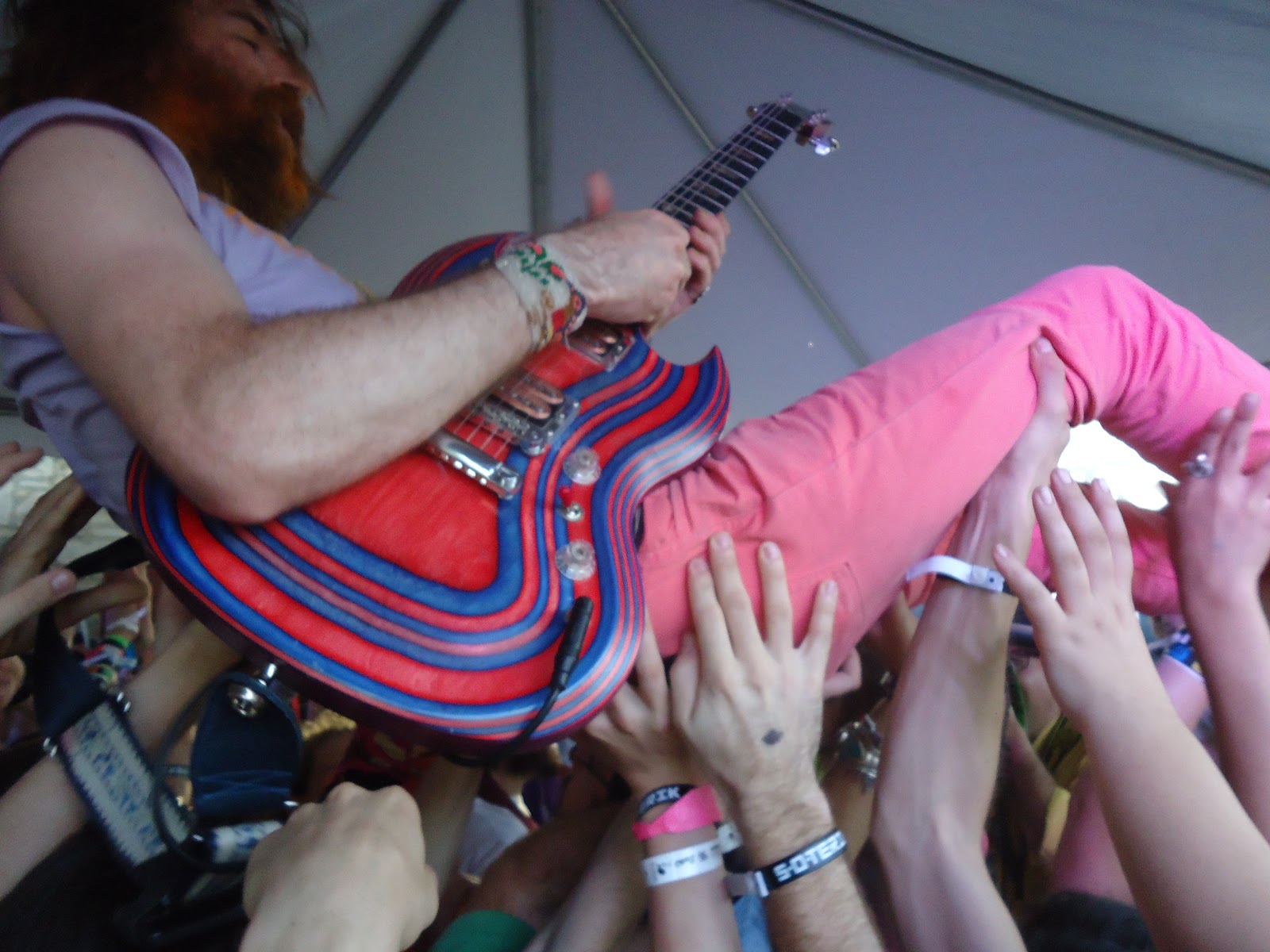

Of Montreal, 6:00pm, Clive Bar
Felt some SX guilt for deciding to see this, and sticking around so long for it (other options included catching the awesome, food-obsessed rapper Action Bronson, or a maybe over-ambitious third attempt at Grimes) – since I have seen of Montreal plenty of times, though not in ages. But whatever. It was great to be in a crowd full of fans, just there to see one of their favorite bands play a concert. This was a seriously of Montreal-loving crowd – they sang along to every word, fist-pumped every beat, and half of them were dressed as crazy and colorfully as the band themselves. (Another half were of course wearing green for, as Best Coast called it later on, St. Party's Day.)

And it was a seriously crowd-pleasing set: nothing but hits, or more specifically nothing from outside of their 2005-2007 apex of popularity. They kicked off with the two big ones from The Sunlandic Twins ("The Party's Crashing Us" and "Wraith Pinned To The Mist"), and the rest of the set was entirely drawn from '07's Hissing Fauna..., including set-closing epic "The Past Is A Grotesque Animal," which ended with, first, guitarist BP Helium crowdsurfing, and then his guitar crowdsurfing by itself, being "played" by the whole audience. Personally, I'd have loved to hear at least some of their more recent stuff, but I was probably a minority there. (Nobody does encores at SXSW, but it's hard to imagine a crowd more doggedly insistent in their clamoring for one. I pitched in with the mini-cowbell I had picked up earlier in the day – inventive swag this year!)


Rittz/Gangsta Boo/Stalley, 7:00pm, Fader Fort
Dinner might have been wise, but the mystery of the 8:00 Fader Fort "special guest" (the characteristically wild rumors swirling included Drake, which, basically, I would have died) not to mention my handy-dandy badge-carrying ability to bypass a monster line outside the bulging venue, were just a bit too tempting. When the outrageously red-haired speed-rapper Rittz (who sounded like an angrier Yelawolf) and former Three 6 Mafiosa/Yelawolf co-sign Gangsta Boo showed up for brief sets in the 7:00 "TBA" slot, I was figuring it was gonna be Eminem (who'd turned up the previous night at 50 Cent's Austin Musical Hall show.) But then Stalley, the self-described "newest" member of Maybach Music took the stage, and stayed on the stage, and stayed on the stage – his beard may be, on a technical level, more impressive than Rick Ross's, but it's nowhere near as lovably iconic or charismatic – and it became clear that, once he finally left, we would be graced with the presence of...


Rick Ross, 8:15pm, Fader Fort
Yep. This happened. Totally ridiculous, totally awesome. Couldn't see half the time because of all the cameras/phones in the air, but I had worked my way maybe three-quarters of the way to the stage by this point, and the energy in the crowd was just delirious. Early in the set, after a couple cuts from his recent mixtape, he whipped through four massive hits ("Hustlin," "All I Do Is Win," "B.M.F.", "I'm On One") in the space of fifteen minutes. I guess, just because he could?

Devon Sproule, 8:55pm, Austin Java
I can't actually tell you about this set, because I wasn't there. What I can tell you is that Devon Sproule is a wonderful wonderful songwriter and one of the most endearing and talented performers I've ever had the pleasure to see, and that I biked fifteen hilly minutes to a semi-remote part of town (well, far outside the SXSW hubbub anyway) to see her, only to learn that it was the wrong Austin Java location, and then, another twenty-plus minutes and some bad directions later, to the correct Austin Java location, where Devon had just finished her set and was loading the car. And I chatted a while with her also-charming, also-a-songwriter husband, Paul Currerri, who told me that they'd just moved to Austin (from Berlin) this week. So hopefully they'll be playing some more, better appointed and better publicized shows at future SXSWs, and hopefully then the (impressively comprehensive, but nevertheless fallible) Austin Showlist website will list the address correctly. (And/or I will remember double-check their info.)


Django Django, 10:00pm, Latitude 30
Buzzy Brits, playing to a sardine-packed room of badgers. Energetic, danceable, slightly synthy rock, with plenty of texture and personality...made me think of Hot Chip, XTC, and other bands I really like. Also, for some reason, their vocal harmonies reminded me a lot of the Dandy Warhols. Not all of the songs made an instant connection, but a few of them did, and I bet their album (if it exists yet) will be very worth hearing. They also had a really big tambourine.


Fanfarlo, 10:00pm, Hype Hotel
I've reviewed two Fanfarlo albums now, and I'm not sure I could recall any of their songs if you asked me to. But they're always perfectly enjoyable when I'm actually listening to them, and they really sounded fantastic live. Epic, anthemic – but somehow not affected or overblown – indie rock stuff, with trumpet and saxophone and violin and big blue lights. Plus, they were adorably Scottish and polite. Nice one.


Best Coast, 11:00pm, Hype Hotel
Bethany Cosentino as a person is as refreshingly straight-shooting and pretense-free as her music, which as she performs it live doesn't even come off as cutesy, just matter-of-fact: she wishes her cat could talk, okay? She made no bones about being pissed off by lame, unenthusiastic SXSW audiences, and asked us if we could just be cool and party with her, for a change. The crowd responded by demanding that she chug the cup of white whiskey she'd been making skeptical remarks about throughout the set. (Meanwhile her guitarist, silent Bobb Bruno, was tossing back a handle of Jim Beam.) She was almost apologetic about playing new songs ("four in a row, is that okay?") but they were some of the highlights of the set, even sandwiched between all the first album faves. (The forthcoming Best Coast album shows, to me, a marked step up in her songwriting and sound – I'm expecting some good things for her this year.)

Wavves, 12:00am, Hype Hotel
Then I got a chair massage from the very cool Kate, which was great except for when Wavves started playing partway through it.


Jacques Greene, 12:40am, Barcelona
SXSW really does not do electronic music well. I guess that's the USA for you. Montrealer Jacques Greene is probably doing as much as anybody these days to underscore the shared fabric of bass music (dubstep/funky/house/whatever) and R&B, and this DJ set was a beautiful illustration of that connection, encompassing everything from Jackmaster to Burial to Moloko's "Sing it Back" and Storm Queen's masterful 2011 soulful house epic "It Goes On," right alongside Waka Flocka Flame, a funky Destiny's Child remix, and Drake/The-Dream's "Shut It Down" (with Greene grinning and singing along to every word) – all in a tight, seamless forty-minute set, pretty much the most exciting, energetic set of dance music you could ask for. (Though as far as I could tell he didn't drop any of his own excellent productions.) But the venue was a cramped, anonymous basement bar, and the crowd, despite several pockets of serious, enthusiastic dancing, seemed inappropriately diffuse and indifferent, mostly hook-up-seeking locals and St. Party's Day revelers who just happened to be there.

Toddla T, 1:00am, Latitude 30
Around the corner, Toddla T seemed be on a similar tip in his DJ set, albeit more populist in his selections (while I was in there SBTRKT's "Wildfire" and Big Sean's "A$$.") Not quite the party I was looking for though.


XV, 1:00am, Hype Hotel
Was on my way to check Flosstradamus but got distracted and pleasantly side-tracked by a prominent Pixies sample blaring out of ye olde Hype Hotel (and, okay, I was running pretty low on tacos.)   Such was my introduction to the very silly, young Wichita, KS (?!) rapper XV. Chipper, vaguely nerdy pop-rap, Chiddy Bang kind of thing. Mindless fun, and sure, why not, as his set-closing single has it, "Awesome." Or something.

Mujuice, 2:00am, Hype Hotel
Never heard of this guy either – I didn't even know who it was when he was playing, as it wasn't listed or anything. But I was pretty impressed by his music, which I was having a hard time slotting into any of the usual electronic-music subdivisions. Subtle, stylish, danceable. Apparently he's "one of the cornerstones of today’s Russian electronica." Okay, cool.

And that was SXSW 2012. Cruised around for awhile (both through the streets and on twitter) trying to track down an afterparty, but it seemed like things had pretty much wrapped up. Diplo was in New Orleans, Rick Ross was allegedly already back in Miami. And it ends, not with a bang, but a well-deserved sleep.

04 December 2009

AMG review round-up, volume XIV: erm, lovably scruffy indie blokes

ye gods, my output around here has slowed to about one post per month lately, but that don't mean i haven't been writing about music. not hardly. got a lotta rounding up to do. so: apropos of the mountain goats (who, onstage the other night, described himself as "a purist of the '90s indie pure"), here are some writings, spanning from nearly a year ago until last night, on a bunch of indie rock guys, singly and in groups, most of whom offer conspicuously 90s roots.

first up, four-ish records by darren "ex-hefner" hayman, who's made great strides in the past twelvemonth towards becoming one of my absolute fave indie songwriter guys, alongside mr. goats, and particularly in terms of my last.fm playcount. then two more i like a lot (even if one put out his best album this year and the other his worst.) then, while we're on the subject, 90s-indie-pure-weirdo julian koster, who otter have called his band weird tapes, but hey at least that singing saw record is seasonable (again). and finally a couple of mediocre indie rock records by bands. oh, ok, the records are fine, it's indie rock itself that's mediocre. why do they still have indie rock bands again? ugh. (except, and there always seems to be an exception, i am really digging on that real estate jawn.) and, oh yeah, i still think the dandy warhols rule ok, plus i got to include some fun topical nerdiness in the intro there. i guess this is as good a place to mention that i wasn't all that jazzed about the lou barlow record, although he seems like a really nice person.

----

Darren Hayman: bio; Secondary Modern, Great British Holiday EPs, and Pram Town reviews

Between 2005 and 2007, Darren Hayman issued a series of four limited-run four-song 7"s written and recorded at various English seaside vacation spots. Initiated as a small-scale, one-off project to distract him from the stress and creative constraints of a protracted legal battle with his former label, the results of the undertaking, collected here in a handsome edition with bonus tracks and a DVD of videos, stand not only as a touching tribute to the fading institution of the Great British Holiday, but as a testament to Hayman's status as one of pop's finest chroniclers of quintessential Englishness, in the tradition of Davies, Partridge, Haines, and Albarn. The whole package has a refreshingly off-the-cuff, homemade charm, from the rudimentary (though perfectly adequate) recordings, which rely primarily on ukuleles, drum machines, and the occasional cheap keyboard, to the simply shot videos, which offer a handy visual complement to the world evoked so touchingly in the songs. And the songs here are some of Hayman's best: most of them engaged with his familiar lyrical themes of the tenderly bittersweet love affairs of ordinary folks, but with a distinctly personal touch notable even in his idiosyncratic oeuvre, and shaded with a particular sense of poignancy and nostalgia. Several of the standouts focus specifically on the bygone era of Hayman's boyhood, including the technological regressionism of the peppy "8-Bit World," the wistful longing of "1976" (which rhymes "turquoise Formica" with "Twiggy or someone just like her"), and "Future Song"'s wry lament that "the future's not what they said it would be in the Sunday papers in the '70s/Where's my monorail, where's my hovercar, where's my robot slave?" For some tastes, the trio of covers added to the collection (of holiday-themed numbers by Connie Francis, Lindsey Buckingham, and Chas & Dave) may perhaps push things too far over the line into whimsy, though they capture a certain legitimate quaintness that's undeniably fitting. On the whole, though, it's hard not to be won over by the sweetness and intimacy of this project, which was clearly a labor of great love for its creator, and is one of the most delightful and illuminating ways to encounter his work.

Pram Town feels, in many ways, like the logical culmination of all that has come before in Darren Hayman's career. He considers it to be his tenth album, which means he's counting the four he made with Hefner, one each with the synth-pop duo the French and the bluegrass outfit Hayman, Watkins, Trout and Lee, and the compiled Great British Holiday EPs, in addition to the two "proper" full-lengths under his own name. That's only fitting, since this album has stylistic echoes of all of those projects, and features musicians from most of them. Lyrically, it's also very much an extension of his past work, which has frequently focused on specific British locales (most notably London, as for instance on Hefner's We Love the City, but also the seaside vacation towns depicted on the Holiday EPs), and typically involves sentimental character vignettes and keenly observed meditations on love and nostalgia, youth and maturity, ambition and ambivalence, and disillusionment in the everyday lives of ordinary people. Those themes are at the heart of this modest concept album, a song cycle set in the "New Town" of Harlow, Essex, which was established in 1947 and affectionately nicknamed "Pram Town" due to the influx of young postwar families. Neither an outright condemnation of this type of now-obsolescent planned community nor a rose-tinted eulogy for a bygone heyday, the album presents a nuanced, bittersweet view of the town (located not far from Hayman's native Brentwood) through the eyes of a narrator who is at times sarcastic, and even scornful (as on "High Rise Towers in Medium-Sized Town"), but at other times genuinely proud (the title track; "Our Favorite Motorway").

The central narrative played out against this backdrop of suburban contradictions is, naturally enough, a love story: boy meets girl (in the utterly delightful, ukulele-led "Compilation Cassette," destined to be a meta-mixtape favorite) and dreams of romantic bliss (the jaunty, bluegrass-based "Losing My Glue"), but grows resentful of the class differences straining their relationship ("Out of My League"), leading to his inevitable heartbreak (the sweetly resigned "Leaves on the Line") and departure. It's a familiar story rich enough to let Hayman explore a decent range of timeless romantic themes, but not so complex that following it ever becomes a chore: crucially, any of these songs could stand perfectly well on its own. Indeed, Pram Town feels, if anything, less specifically character-driven than the majority of Hayman's work. Apart from the lovers, who remain nameless and archetypal, the only other significant characters listeners meet are (typically enough) a couple of musicians: going-nowhere local heros Amy and Rachel, who "mix R&B and death metal," though needless to say their ode here doesn't sound anything like that. Clearly, the character that Hayman is most interested in is Harlow itself; his treatment of the town, and its inhabitants' generalized love/hate relationship toward their home, is genuine, well thought-out, and entirely compelling. And while the album may not strike much new ground musically, the songs are uniformly strong and intriguingly diverse, featuring lush and varied folk-pop arrangements with an abundance of brass, banjo, and burbling vintage electronics. This is easily Hayman's most consistent and cohesive solo effort to date, and one of the most successful and satisfying records of his entire career.

Hayman, Watkins, Trout and Lee: bio and Hayman, Watkins, Trout & Lee review

Hayman, Watkins, Trout & Lee describe their music as East London bluegrass -- not to be confused, perhaps, with the North London variety pioneered by the Kinks on Muswell Hillbillies -- and while they might not pass muster for strict traditionalists, they do make an impressive showing for a ragtag band of Anglo amateurs. Actually, although the most noteworthy names in this laid-back supergroup are a couple of indie rockers (Hefner's Darren Hayman and the Wave Pictures' Dave Tattersall), they've got an ace in the hole in "proper folky" Dan Mayfield, whose fiddle work adds some assured authenticity to instrumental breakdowns like the traditional "Buckdancer's Choice" and passable original "Beulah Crossing the Marshes." Dave Watkins' banjo playing's not bad either, but virtuosity clearly isn't nearly as relevant here as energy and enthusiasm, which this gang have got in spades. The group's chief priority to date has been nothing more ambitious than playing around Hayman's kitchen table, and the album has the light-hearted, infectious feel of an impromptu jam session. That low-stakes looseness can also make it feel fairly dispensable, although it's hard to imagine not enjoying it at least somewhat. Certainly, your patience for these affable but slight renditions of "Hesitation Blues," and especially Huey Smith's goofy "High Blood Pressure," will depend a good deal on your tolerance for Hayman's scruffy, less-than-mellifluous vocals (or Tattersall's -- they're tough to tell apart.) The pay-off, though, is in the originals which make up about half the record, particularly Tattersall's sweet waltz-time come-on "Fine Young Cannibals" (nothing to do with Roland Gift), and several of Hayman's contributions, including the sprightly, saucy "Dirty Tube Train" and the superb low-rent love song "Sly & the Family Stone" (nothing to do with Sylvester Stewart), which should gratify his fans considerably. The countrified cover of the Mountain Goats obscurity "Jam-Eater Blues" is also an inspired performance and an inspired choice, featuring a lyrical mantra -- "life is too short to refrain from eating out of the jar" -- which aptly sums up the kind of gusto that Hayman et al. bring to this singular, endearing little record.

----

Jeffrey Lewis [& The Junkyard]: 'Em Are I review [City & Eastern Songs review forthcoming]

The bandaged-head cover cartoon and cutesy title wordplay of Jeffrey Lewis' fifth album provide a decent indication, for the uninitiated, of the N.Y.C. songwriter/illustrator's goofiness and droll wit, qualities that are evident in many of the songs contained within. But they also hint, cleverly and somewhat obliquely, at the album's surprisingly weighty subject matter: though not specifically medical in focus, most of these songs are concerned with death, existential pain, and the otherwise more corporeal aspects of the human experience. Actually, "concerned" may be the wrong word -- far from morbid, Lewis often sounds insouciant and practically gleeful in his perspectives on mortality, especially on the screwy bluegrass stomper "Whistle Past the Graveyard" and the jaunty "Good Old Pig, Gone to Avalon," a fond eulogy to a beloved porker (with some suitably unhinged soloing courtesy of J Mascis). The tone-setting two-chord talking blues "If Life Exists(?)" and the wistful "To Be Objectified," with its hippie-dippie philosophizing, are more pensive and brooding, but they maintain a generous and optimistic outlook, with Lewis' affably nasal delivery dotted with jokey self-reference and the occasional groan-worthy one-liner. Best of all is "Bugs and Flowers," a mellow ramble that finds Lewis out walking along the tracks, ruminating on growth, decay, and universal oneness, in a touchingly quirky and unaffected fashion. It's not all mortality and metaphysics: "Roll Bus Roll" is a sweet if world-weary ode to bus travel; scrappy opener "Slogans" offers a series of motivational affirmations, more or less literalizing the album's titular pun along the way ("Everyone you meet is you/Divided by what they've been through"); and the self-castigating "Broken Broken Broken Heart" is an endearingly honest take on good old-fashioned lovesickness (complete with a bouncy singalong chorus). All of these are very good tunes, but it's the heartfelt content at the album's thematic core that makes 'Em Are I not just Lewis' most consistent album, but also his most truly affecting and easily his most successful outing to date.

John Vanderslice: Romanian Names review

John Vanderslice is nothing if not consistent. He's never made a bad record, and although his idiosyncratic songwriting and production have only grown more confident and compelling with his last several releases, neither has he made one that is truly, unabashedly great. Romanian Names does little to change any of that, news that should be at once heartening, slightly disappointing, and ultimately entirely unsurprising to his followers. A couple of minor, outward things are different this time around. After six albums on Barsuk, Vanderslice has jumped ship to the increasingly eminent Dead Oceans imprint. He's also decided to shake up his writing process by hammering the songs out in a new basement studio at home before fleshing them out at Tiny Telephone, his usual HQ. Songwise, the results are subtle and few: save perhaps the sprightly, hummable "C&O Canal" and a pair of lovely ballads, "Too Much Time" and "Hard Times," these numbers aren't discernibly more direct or immediate than prior efforts. The album's sound is a typically Vanderslicean mix of inventive chamber orchestration, dappled electronic overtones, and scruffy acoustic indie pop guitars, a step back from the mildly more organic orientation of Emerald City to the variegated textures of Pixel Revolt, though in keeping with both of those albums' gentle, accessible veneer. In terms of the lyrics -- always a crucial factor with Vanderslice -- this may rank as his most oblique work, and not merely because the liners, atypically, lack a lyric sheet (although that could be taken as a clue to his intent). His familiar character-driven approach is largely intact, but the details are sketchier than usual, with few clear narratives emerging despite recurrent references to fraught romantic exploits, loss, violence, memories of summertime, and isolation in wilderness settings. The lack of specificity can be refreshing, with simple chorus phrases and potent, isolated images (notably, of fetal horses galloping in the womb) taking the place of involved story lines. Too often, though, the songs just feel enigmatic and empty. Aside from "Fetal Horses" and the several standouts mentioned earlier, there's strangely little here to hold on to, lyrically or otherwise, making Names an oddly evasive, impenetrable listen. Not great then, though not bad, Romanian Names holds the unfortunate and surprising distinction of being the very first John Vanderslice album to feel like just another John Vanderslice album.

----

The Music Tapes: Music Tapes For Clouds and Tornadoes review

From the sound of things, not all that much has changed for Julian Koster in the nine years since his Music Tapes project made its somewhat perplexing initial appearance with First Imaginary Symphony for Nomad. Music Tapes for Clouds and Tornadoes finds the elusive, eccentric Koster still fixated on homemade and otherwise unconventional instruments (including such creations as a "fun machine" and "the Seven Foot Tall Metronome," along with his trusty banjos and otherworldly singing saws); still futzing around with archaic recording methods (no Edison cylinders this time around, but the credits do list a record lathe, a wire recorder and ribbon microphone from the 1930s, and several pieces of equipment from the '50s and '60s); and still warbling dreamily to, for, and about insentient entities and natural forces (in this case, as the title suggests, mainly meteorological phenomena, and also reindeer). There are some definite musical developments here, most notably a shift away from the jumbled sound collage aesthetic to a more direct and melodic song-based approach, but the most striking change may be one of context. Whereas Nomad was released at the height of the Elephant 6 Recording Company's prolificacy and success, and got somewhat overlooked in the shuffle, the intervening years have seen the E6 collective's output dwindle and then essentially halt altogether, while its stature and the cult fascination with its works (most prominently Neutral Milk Hotel's In the Aeroplane Over the Sea, to which Koster was a significant contributor) have continued to increase; the upshot being that considerable attention was paid to this new offering.

That attention turns out to be absolutely warranted, for Clouds and Tornadoes is a fascinating and often compelling creation that effectively constitutes a vigorous and unexpected resuscitation of the long-dormant Elephant 6 spirit -- particularly when taken in conjunction with the Apples in Stereo's entirely different New Magnetic Wonder (the only other major record since 2002 to bear the E6 insignia, and in some ways this album's polar opposite, although both feature an extensive list of contributions from many of the collective's musicians). Specifically, Clouds marks the return of E6's more idiosyncratic and less directly pop-oriented tendencies -- it does, indeed, evoke the sepia-toned antiquarianism and fragile intimacy of NMH, and to a lesser extent the fractured, surrealist fuzzy warbles of the Olivia Tremor Control axis. All that said, this is incontrovertibly Koster's record, the product of his singular vision, which can only really be taken on its own unique terms. Many listeners are likely to be put off by his unapologetically wailing bleat of a voice, which he strains to the point of maximum expressive poignancy (or vexation, depending on your take); similarly, his quaintly whimsical lyrics are liable to come off to less charitable listeners as hokey, insipid babble. But those either charmed by or willing to indulge these excesses enough to engage with the strange music contained here will find much to marvel at, both in the album's songs -- which gesture intriguingly at fusty folk forms, bygone back-porch balladry, golden-age silver-screen pop, marching band music, and more without really coming close to anything recognizable, or certainly anything remotely like conventional indie rock -- and in its sounds themselves, which are at least equally important in conveying you off to its curious, self-contained little world.

Julian Koster: The Singing Saw at Christmastime review

Julian Koster, quirky frontman of the Music Tapes, Neutral Milk Hotel member, and go-to singing sawman for the Elephant 6 collective in general, steps out on his own here with a holiday album that makes a stunning showcase for his prodigious saw-playing talents. Or rather -- as his whimsical liner notes would have it -- his talent for encouraging saws to sing, which they actually do all by themselves. ("Hark! The Herald Angels Sing," the only selection hear to feature a sound -- copious clanging bells -- other than saws, purports to be a field recording from a traditional Christmas Eve saw gathering.) The saws here, singing both alone and in gloriously harmonized duos and groups, offer up renditions of a dozen well-known Christmas songs and carols, and the results are entirely magical; at once wonderfully eerie and strangely comforting. Rendered in the high, lonesome, otherworldly wobble of the saws' voices, even the most frolicsome of holiday tunes ("Frosty the Snowman," "Jingle Bells") become haunting and solemn, but Koster wisely devotes much of the album to the season's more poignant, plaintive melodies ("Silent Night," "O Little Town of Bethlehem") which here feel utterly serene and angelic. As evocative as it is impressive, The Singing Saw at Christmastime is a refreshingly different and eminently listenable offering that should easily become a yuletide favorite.

Throw Me The Statue: Creaturesque review

In the two years or so since their debut's initial self-release, Throw Me the Statue have grown from a one-man home-recording project to a full-fledged rock band. But don't expect a radically revamped sound with album number two: Creaturesque might be slightly more assured and fuller-sounding than the amiably scrappy Moonbeams (credit in part the contributions of Northwest indie rock super-producer Phil Ek), but TMTS have hardly lost their meandering mid-fi charms. Their sunny, lushly layered off-kilter pop songs still boast plenty of tinny drum machines, synth organs, jangly acoustic strumming, occasional bits of trumpet and glockenspiel, and of course Scott Reitherman's blithely casual singing and obliquely evocative lyrics. So it's essentially more of very welcome same. That said, the pop thrills aren't nearly as immediate this time out -- there's nothing here to rival the instantly grabby hooks of first album standouts like "About to Walk," "Yucatan Gold," and (especially) "Lolita." The closest thing might be "Hi-Fi Goon," a somewhat uncharacteristic rocker that recalls prime Built to Spill (with shades of Weezer's "Sweater Song"), though the bouncy "Dizzy from the Fall" and mellower "Noises" scratch that indie pop itch reasonably well, too. Elsewhere, the brief "Baby You're Bored" (is that an Evan Dando reference?) is nearly hummable and inscrutable enough to pass for a Guided by Voices cut, albeit far too well recorded, while "Tag"'s dense rhythms and falsetto harmonies are undeniably Shins-ish. In general, the brightest spots here come through fleeting individual moments -- like the sudden influx of barreling gospel-style backups toward the end of the gradually cresting opener, "Waving at the Shore" -- and more subdued numbers like the shambling, gently glowing closer, "The Outer Folds." Creaturesque's subtler pleasures may require more time to sink in than the impulsive skinny-dip plunge of its predecessor, but fans of classic-styled melodic indie rock will find it every bit as summery and inviting as the backyard swimming pool on the cover, and well worth the wade.

Fanfarlo: Reservoir review

For anyone who's paid the least attention to the tasteful, tuneful, nebulously rootsy strain of indie rock that was in ascendance throughout the mid-to-late 2000s, Fanfarlo's debut album will sound instantly and inescapably familiar. The London-based quintet favor a genial affect, moderate tempos and blend of orchestral (violin, trumpet) and folksy (mandolin, accordion, harmonica, saw) instrumentation akin to acts such as The National and Grizzly Bear, while vocalist Simon Balthazar's broad, heartfelt crooning invites immediate comparisons to Beirut's Zach Condon. Most of all, it must be said, the band display an undeniable similarity to The Arcade Fire, with whom they share all of the above-mentioned qualities as well as a distinctly earnest, quietly dramatic emotional fervor. If anything, the imitation is a slightly pale one – even at its most impassioned, their brand of chamber-pop bombast is never as potent and unrestrained as that Montreal outfit – but if they're unlikely to inspire unbridled passion in most listeners, the familiarity of their sound should breed plenty of contentment. Fanfarlo are at their best when their lush but occasionally dreary instrumental efforts are focused around a strong, simple melody, as is frequently the case here – on slightly pop-leaning cuts like "Fire Escape," "The Walls Are Coming Down" and "Harold T. Wilkins," and particularly on the sweet piano-led ballad "If It Is Growing." That said, the most striking thing here may be the opener, "I'm A Pilot," which impresses as much with its hypnotically slow, chugging rhythm (provided by footstomps and sleigh bells) as with Balthazar's typically wailed (and particularly Win Butler-ish) vocal turn.

The Dandy Warhols: The Dandy Warhols Are Sound review

The Dandy Warhols opened their 2003 album, Welcome to the Monkey House, with a brief, snide dig at record industry greed and illogic that ran, in part: "When Michael Jackson dies, we're covering 'Blackbird.'" The line was obviously intended as a flip reference to Jacko's control of the Beatles' publishing rights -- of course, "Blackbird" is a rather fitting song to record as a eulogy, though it's doubtful that the Dandys considered that at the time. But fate had some amusingly ironic, if insignificant, tricks in store when, six years later, Jackson's unexpected death occurred mere weeks before the release of an alternate version of that same album -- a version whose initial release had been prevented by the Dandys' own industry woes, and which featured all of the same songs except for the sadly newly relevant titular ditty. The story is that the bandmembers took the tracks (which they had co-produced with Duran Duran's Nick Rhodes) to be mixed in New York by Russell Elavedo (D'Angelo, Common, the Roots), but the results were rejected by Capitol Records and shelved in favor of a new version mixed (apparently without the band's involvement) by British pop engineer Peter Wheatley (Sugababes, Girls Aloud, Sophie Ellis-Bextor), which was released to mild but vaguely disappointing success and ended up as their second to last album for the label. The differences between the two versions, as fans heard once the Elavedo mix (dubbed The Dandy Warhols Are Sound) was self-released by the band in 2009, are roughly what one would expect after comparing the two engineers' prior clientele rosters. Not that these mixes make the Dandys sound like a grittily organic hip-hop/soul outfit on the one hand, or a glistening chart-pop act on the other -- this is essentially a rock & roll album either way -- but Sound is notably more stripped-down and spacious, with fewer of the synthesizers and electronic underpinnings that gave several Monkey House tracks their noted (and arguably prescient) new wave/synth pop vibe.

This helps to bring the songs closer to the rootsier, dirtier, and somewhat dubby approach of their previous albums, although it's hardly comparable to the gloriously noisy dronefests of their first two -- even if shifting "(You Come In) Burned" up, to open the album with a slow-building epic, is a nice nod to Dandys tradition. But yes, in a word, Elavedo's version is less poppy, even if in some ways it actually feels cleaner and more direct, since fewer layers of sound allow the songs to stand more fully on their own merits. (This is particularly true of easily overlooked numbers like "Heavenly" and "Rock Bottom," though it's not always necessarily to their benefit.) The big pop numbers -- which are now mostly slotted in a clump at the beginning of the record -- lose almost none of their tight, hooky appeal. Listening to both mixes side by side, song for song, the differences are readily evident and fairly striking -- though there are no substantive changes to the actual songs themselves. Oddly, though, listening to either version in full makes it much harder to notice any prominent differences, perhaps because of how well the tracks are incorporated into each version's distinct sound-world. Ultimately, the differences between the two are not all that great. Sound may have a slight edge over the originally released version of this material, if only because it's truer to the band's initial intentions, and Dandy diehards will certainly find it worth checking out, but more casual fans who already own Monkey House can probably skip it unless they're looking for an intriguing lesson in the nuances of mixing. (The "new song," "Pete Int'l Spaceport," is merely four minutes of ambient effects washes, and should hardly be considered a selling point.)