
whoa yeah. i had a bit of a hard time deciding what "soul" means here – initially was gonna be more strictly just the retro-folks that mostly make up the middle chunk, but i ended up expanding the parameters a bit...not too broad though: i think all this stuff is pretty soul-y. better decade for soul than rock then? definitely the best soul decade of the last three, no question (and the worst for rock...yeah.) i like that this is exactly evenly split (and largely down the middle) between the soul sistas and the soul brothas.
ran especially long because i had to give fuller-than-standard airings to a bunch of these (and, there are a bunch of them...)
#12: soul siblin's [22:33]
Alicia Keys - No One (2007)
Brandy - Camouflage (2008)
Joss Stone - Super Duper Love (2003)
Beyoncé - Sugar Mama (2006)
Mya - Fallen (Zone 4 Remix ft. Chingy) (2003)
Mary J. Blige - No More Drama (2001)
Maroon 5 - This Love (2004)
Mayer Hawthorne - Make Her Mine (2009)
Amy Winehouse - You Know I'm No Good (2007)
Sharon Jones and the Dap-Kings - How Long Do I Have To Wait For You (2005)
Jamie Lidell - Multiply (2005)
Owusu and Hannibal - What It's About (2005)
Gnarls Barkley - Crazy (2006)
Maxwell - Pretty Wings (2009)
Justin Timberlake ft. T.I. - My Love (2006)
NOMO - One To One (2006)
19 January 2010
2000s mixburst #12: soul


20 July 2009
AMG review round-up, volume XIII: strictly retro revival resurgence
"it's very difficult to keep the line between the past and the present..."
- "Little Edie" Bouvier, as quoted in Grey Gardens and sampled by Rufus Wainwright on "Grey Gardens"
seems like nothing's old for long before it's new again; seems like these days there's more interest than ever in what's gone before – though revivalism is hardly new itself; of course, the more time goes by the more past there is to revisit... anyway there's all sorts of interesting ways to think about retro-referencing music (and music is probably the arena where this phenomenon is most pronounced and most complex, music being about fashion as much as it is about art), even if it does start to get old.
here are some recently releasted records i've reviewed which refer overtly, with greater and lesser degrees of directness, to the music of the past, in various genres: first three soul albums (one revivalist, one new-old-schooler, and one reissue), then a decade-spanning comp of ethno-beat-soul; four new-ish takes on the rock of different eras (roughly, the '80s, '70s, late-'60s, and early-'60s) and lastly a retro-electronica album, which sort of brings up a whole new set of issues... (though it's also sort of same-old same-old.)
but, goodies: Nicole Willis: Keep Reachin' Up review
After a pair of essentially modern-styled R&B outings, the Brooklyn-born, Europe-based vocalist Nicole Willis struck out in a new direction on her third full-length, teaming up with Finnish funk combo the Soul Investigators in 2005 for a hearty take on '60s and '70s stylings which, by accident or design, fit right in with the vintage soul resurgence that was then getting underway. Relative to other diva-led throwback acts such as Sharon Jones and Amy Winehouse, Willis and her cohorts come off as especially convincing revivalists (or especially deceptive simulators), despite seeming comparably laid-back about taking an authentically "retro" approach, or at least about sticking to one particular type of soul. Stylistically, they trend toward the more polished, pop-oriented Northern Soul end of things, occasionally using strings in place of horns and generally keeping things up and peppy, on stomping highlights like "If This Ain't Love," "Invisible Man" (which features girl group-styled falsetto backups sung by noted dance producers Maurice Fulton and Jimi Tenor, who's also Willis' husband) and "My Four Leaf Clover," which nods specifically and delightfully to early Motown and to Martha & the Vandellas in particular. Opener "Feeling Free," which boasts the album's most uplifting and irresistible chorus hook, sports a similarly chunky early-'60s backbeat wrapped in a lavish arrangement of strings, bongos, and palm-muted guitar that suggests more of an early-'70s, Philly International vibe, whereas the slightly groovier "A Perfect Kind of Love" lays on the Stax-style horn parts and chicken shack organ. The detours into harder-headed funk ("Holdin' On" and the title track) and smoky balladry ("Blues Downtown" and "No One's Gonna Love You") are somewhat less effective: despite some compelling and atmospheric playing from the Investigators, Willis' voice isn't quite richly textured enough to be as effortlessly authoritative here as it is on the more melodic, poppier material. Still, these tracks are far from serious missteps, and they do add some well-intentioned variety to an album that, on the whole, stands as one of the finer soul full-lengths of the decade.
 Naomi Shelton and the Gospel Queens: bio and What Have You Done, My Brother? review
Daptone Records, arguably the epicenter of the 2000s funk/soul resurgence, has launched records by retro-styled revivalists (the Budos Band, the Mighty Imperials), reissues of vintage-era obscurities (Bob & Gene), and even reissues of revivalists (the Daktaris, the Poets of Rhythm), but for a long time the label lacked another act that could compare with its flagship star, Sharon Jones, a bona-fide throwback soul artist with roots in the music's heyday who's still very much musically active today. Enter Naomi Shelton, a commanding and full-throated vocalist whose musical identity stems equally from her churchgoing rural Alabama childhood in the '40s and '50s and her tenure on the New York club scene in the '60s and beyond. Like Jones, hers is an undeniable, inimitable voice, a rich and gritty alto brimming with authority and hard-earned authenticity, but also an unmistakable sense of compassion, grounded by a forthright, soberly pragmatic sensibility. What Have You Done, My Brother?, the first full-length Shelton has cut in her long and varied career, is a gospel record, to be sure -- from the reedy organ notes that open the proceedings to the inspiring lyrical message of uplift and righteous struggle, bolstered by the sturdy and stirring backing harmonies of the Gospel Queens -- but it's a soul record, too, just as obviously, and one that bears many of the hallmarks of Jones' Daptone sides. Along with a number of traditional and classic gospel numbers, most familiarly Sam Cooke's timeless "A Change Is Gonna Come" (which sounds as affecting as ever, and more personally informed than usual, in Shelton's relatively unadorned take), she's blessed here with a handful of top-notch original tunes by Daptone ringleader Bosco Mann (aka Gabriel Roth) which, true to form, are practically impossible to distinguish from the older songs -- although the socially conscious, mock-deferential "Am I Asking Too Much?," which is rather atypically sardonic, does feel particularly like one of Jones' groovy struts. Roth also serves as producer and plays bass, alongside fellow Dap-Kings Tommy Brenneck and Homer Steinweiss, while Jones herself is one of several supplemental background vocalists, in addition to the Queens (two of whom take turns on lead vocals.) Suffice it to say, fans of Jones and/or the label won't be too surprised, and certainly shouldn't be disappointed, by what they hear here, even those who wouldn't typically be inclined to listen to a gospel record. And, thanks perhaps to the understated influence of the band's arranger and musical director Cliff Driver, or to Shelton's unaffected sincerity, or simply to the directness, optimism, and relevance of the music's spiritual message, this set is blissfully free of the occasionally over-earnest schtickiness that can sometimes creep into Daptone's more retro-minded output: this is real, and this is righteous.
 Betty Padgett: bio and Betty Padgett review
The 2000s-era soul resurgence has seen a bumper crop of rediscovered and/or rehabilitated "lost" R&B records, gushed-over, too-good-to-be-true reissues of vintage sides that, surprisingly often, have in fact turned out to be that good and that true. Luv N' Haight's re-pressing of this Floridian find from 1975 feels archetypal of these regularly scheduled revelations to an almost unbelievable extent, from the smorgasbord of rare groove styles on offer (sweet Southern soul, groovy proto-disco, Latin-tinged funk) right down to the given name its unheralded titular diva shares with Mmes. Wright, Davis, Swann, LaVette, Harris, and Everett. But believe it, baby: Padgett's pipes are as potent as any of her fellow Bettys (or Bettyes); on the smoother, sweeter side of the spectrum, but soulful to be sure (and uncannily belying her shy 21 years when this was recorded), while the grooves, cut by a crack team of South Florida funk cats, make for grail-worthy gravy. Marquee two-parter "Sugar Daddy," a regionally successful disco single laden with congas, flutes, ear-candy party patter, and some particularly fluffy gold-digging lyrics, is serviceably fresh and funky, if not necessarily Padgett's greatest vocal turn (mostly thanks to its middling melody). The jazzy, sultry, and subtly synth-laced groover "Gypsy of Love" promises a goofy good time as well, but the album's true highlights tend to be those that de-emphasize the disco elements in favor of timeless, backward-looking soul, like the pained but punchy "It Would Be a Shame" and string-laden ballad "Love Me Forever." Best of all is the quartet of cuts that rest, somewhat surprisingly, on an impeccably fluid foundation of Jamaican reggae and rocksteady, over which Padgett croons her romantic pleas and plaints like a Stax/Volt Marcia Aitken, or perhaps one of her U.K. contemporaries in the nascent lovers rock scene. Just a listen to the unrequited schoolgirl love saga of "My Eyes Adore You," with its beautifully self-harmonized chorus, is enough to remind listeners, yet again, that crate-digging dreams really do come true.
 Rich Medina & Bobbito: The Connection, Vol. 1: Modern Explorations in Afro-Beat and Afro-Latin review
Rich Medina and Bobbito "Kool Bob Love" Garcia -- among many other distinctions -- are veteran DJs who've been wooing groove-lovers and setting dancefloors ablaze for years; at home (in Philly and N.Y.C., respectively) and worldwide; individually and, since 1997, together, at their long-running "Happy Feet" parties. True to its title, their first joint release finds the pair delving deep into the well of contemporary, groove-based music from around the globe, often cross-pollinated with funk, soul, jazz, house, hip-hop, and more, but always firmly rooted in African and Latin rhythmic traditions. The set is presented as a straight, unmixed compilation rather than a blended DJ affair, with each compiler responsible for one generous 12-cut disc (many of the inclusions stretch out well past the five-minute mark), allowing each of them ample space to flesh out a distinct genre-based approach. Medina's Afro-flavored disc kicks things off with a sturdy Fela-styled groove from the Dutch group AIFF before settling into a relatively smooth and mellow mode for much of its length, focusing on cuts that project an affably relaxed vibe despite plenty of percussive complexity. Things definitely heat up toward the end of the disc, though, with a vintage nugget from Nigeria's Sir Victor Uwaifo slotted next to more recent but retro-inspired horn-heavy funk from the Daktaris and Azuka of Afrika, and a pair of lengthy tracks offering surprisingly different takes on the intersection of Afro-beat and house music. The NuYorican Bobbito's Latin-based disc is decidedly the more varied and modern-feeling of the two, with a wealth of hip-hop and electronica-inflected selections ranging from Rob Swift's cut-up turntablism to the poppy, salsa-tinged R&B of London's Grupo X (on the aptly-named "Sunshine"), the jazzy lounge-house of Big Bang and Louie Vega, and Reel People's funky, syncopated electro-soul. There's also some relatively straight-up funk/soul by the dependable Quantic, and revelatory interpolations of familiar tunes by Michael Jackson (by the Parisian salsa-funk outfit Setenta) and James Brown (Saravah Soul's excellent "Supersossego," which morphs unpredictably from a faithful instrumental cover of "Super Bad" into a full-on samba blow-out.) As with the first disc, the focus here is on currently active artists, with several cuts as recent as 2008 (though they may not all sound like it), but Garcia does dig back into the vaults for a slice of circa 1974 funk-rock from Mexico's Tequila and a beguiling, dusty-sounding vocal turn from Elenita Ruiz con Conjunto that closes the set, fittingly enough, in an entirely unexpected fashion. All told, it's a treasure trove of consistently fine and highly obscure material that should delight crate-digging collectors and casual listeners alike. Perhaps the best part of all: this is only Volume One.
~~~~~
 Hot Leg: Red Light Fever review
By the time Justin Hawkins announced his departure from the Darkness in 2006, the band's flamboyant frontman had picked up a cocaine habit which suggested he'd been taking his role as an unapologetic resuscitator of hair metal's hedonistic excess regrettably seriously, even if taking things seriously seemed otherwise utterly foreign to the Darkness' M.O. By 2009, however, Hawkins was out of rehab, several years sober, and ready to rock once more, though by no means was he ready to tone down the glorious extravagance of his self-styled Man-Rock. His new outfit Hot Leg, despite a somewhat feeble name, carried forth his former band's outrageously schticky spirit essentially unaltered; if anything, they're even more over the top -- in musical terms, glammier, or more specifically, Queenier -- than the Darkness were. Stripping back the slightly ponderous tendencies that plagued that band's de facto swan song, One Way Ticket to Hell, the light-hearted Red Light Fever feels like a return to the giddy immediacy of their earlier days, with the emphasis placed squarely on righteously hooky riffage and the marvel of falsetto that is Hawkins' "truth larynx." There are some incandescent choruses here: the multi-tracked sugar rushes of "You Can't Hurt Me Anymore" and "Whichever Way You Wanna Give It" recall the pop confectionery of "I Believe in a Thing Called Love," although they suffer (as does much of the album) from verses that are rather less memorable. First single "Trojan Guitar" is a ridiculously epic romp that makes excellent use of a medieval battlefield narrative (possibly an allegorical telling of Hawkins' personal saga with and since the Darkness), but a couple of the album's better hooks are undercut by lyrics that feel, improbably enough, too frivolous, especially the anti-reality TV rant "Ashamed" and the jokey slag-off "I've Met Jesus" (though its punchline is worth a chuckle.) The peppy, cowbell-laden "Cocktails" seems pretty dire on that score too, with verses that offer little more than a list of mixed drinks, but it's all just an endearingly sophomoric excuse for Hawkins to repeat the syllable "cock" a dozen or so times in the ludicrously irresistible chorus. If that didn't make it queer enough for you, "Gay in the 80s" is a relatively straightforward, if slight, ode to coming out in the decade of excess, though despite some lovely choral vocals it's one of the less musically flamboyant cuts here. Above all, Red Light Fever is simply a blast from start to finish, with even the handful of relatively forgettable tracks managing to offer something of interest, like "Chickens"' preposterous operatic wails and "Kissing in the Wind"'s perfectly pitched harpsichord breakdown. So even if they never quite reach the heights of their predecessors' finest moments, Hot Leg are still a tremendous amount of fun; solid proof that there is light (and certainly lightness) at the end of the Darkness.
 Baby Teeth: Hustle Beach review
There's no question that Chicago's Baby Teeth draw heavily and heartily from the classic rock and power pop of the 1970s. It can be trickier to say whether the results constitute jokey pastiche or sincere homage, but that confusion seems entirely appropriate -- and the distinction almost irrelevant -- when you consider that the '70s were an era when playfulness and emotional earnestness coexisted in rock music far more easily than they typically do today. (Take, for instance, the work of the Todd Rundgren, Electric Light Orchestra, and Meat Loaf with Jim Steinman, all of whose influence is readily evident here.) So, when "Big Schools" opens the album with an anthemic rock flourish and a picturesque, writerly evocation of Classic American Collegiate Romance (frat party, freshman year, "...your friend's boyfriend was working the door..."), it feels somehow insincere; a pat, too-perfect mimicry of Springsteen's nostalgia-fueled narratives (or maybe more precisely the second-degree nostalgia of the Hold Steady -- in the songwriting blog project which generated much of this album's material, front Tooth Abraham Levitan acknowledged the song's debt to their "Stuck Between Stations.") But as its story arc develops into a sort of stock mini-epic, with the characters graduating to the dissatisfactions of suburban parenthood, the song grows genuinely affecting, largely due to how fully it embraces the caricature, with all the right musical touches down to the cowbell and a Roy Bittan-esque piano break. Some of the other stylistic excursions here -- the blue-eyed R&B ballad "I Hope She Won't Let Me," the proggy, hard-rocking title track, and the bizarro heavy blooze of "Snake Eyes" -- aren't quite as convincing, in part because Levitan's usually quite serviceable and personable voice tends to sound a bit silly and even grating when he pushes it too hard. But as long as he sticks with more straightforward upbeat pop/rock, which is most of the time, he's got the hooks and the witty charm to make it work -- both for goofs like the high school stalker ode "Shrine" ("every day for lunch I eat what you eat/for science fair I studied the way you sleep") and more sincere numbers like the closing piano lament "It's Hard to Find a Friend" -- and most of the album is a pure, understated joy, striking just the right balance of braininess, frivolity, and heart.
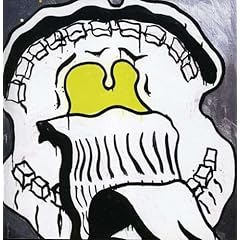 Snake and Jet's Amazing Bullit Band: bio and X-Ray Spirit review
Snake and Jet's Amazing Bullit Band's X-Ray Spirit crashes open with the spiky organs and tinny drums of "Ten Cities Beyond," one of the most infectious bursts of retro garage pop to emerge from Scandinavia since the Caesars' "Jerk It Out." It's a good deal more hectic and reckless than that Swedish iPod staple (which is recalled more directly in the organ lick of "Doom City") but at least as much fun, even if the vocals are completely incoherent and largely incidental and the "period" vibe is thrown off by some disorienting synth squelches. It's clear from the outset that this Danish duo has little interest in faithfully recapturing the particulars of the Nuggets-style rock & roll and surf music that they equally clearly idolize, displaying a striking lack of concern for a conventional pop notion like "song structure" or "arrangement" or even "melody" (though they've also got the chops to offer up a barrage of hooks when they feel like it). Which is, for the most part, tremendously refreshing. The prevailing mood is one of spirited sloppiness, coupled with a bombastic goofiness that vaguely recalls early Beck, and for the most part it works. They're more or less reshuffling the same handful of elements throughout the record (even reusing their own lyrics on a couple of songs), but enough variety and spontaneity are here to keep things unpredictable. And at just over half an hour, there's hardly time for X-Ray Spirit to wear out its welcome, even if the few numbers that veer slightly toward standard indie punk can get a bit grating, especially vocally. They may not be traditionalists in the typical sense, but when they're on, Snake and Jet manage to reinstate a lot of the wildness and weirdness that made rock & roll so great in the first place.
 The Tremolo Beer Gut: Nous Sommes The Tremolo Beer Gut, Qui Le Fuck Êtes-Vous? review
The Tremolo Beer Gut lay it down thick and filthy on their awesomely named third long-player, and first in eight years, a solid half-hour of straight-ahead spy-tinged surf rock. Though these Danes (and one Swede -- Per Sunding of power pop greats Eggstone) clearly have a keen and stylistically relevant sense of humor when it comes to song titles and visual design, their musical approach is refreshingly no-nonsense, hardly reliant on the kind of kitschiness you might expect from a group whose output is so firmly rooted in a sound that's over 50 years old. Which isn't to say that this record isn't a tremendous amount of fun, merely that it has an impressive amount of substance to back up its oh-so-crucial style. The Beer Gut are as accomplished as performers as they are as composers (and particularly melodists, being Scandinavian and all), stretching out with some impressively intricate arrangements which complement the obligatory clean-toned, lavishly reverbed guitars with organs, vibes, pedal steel, and more. And every so often they do see fit to throw in a vocal carrying-on and even a punchline or two, as with the animal noises and maniacal laughter of "Zoo Bizzare" and the sadistic countdown of "9 Times the Pain." If you enjoy surf music and have any interest in hearing a contemporary (but scarcely modernized) take on the genre, these guys are well worth getting to know; and you won't need to know Danish -- or even French.
~~~~~
 Kikumoto Allstars: bio and House Music review
Stylistic revivalism in electronic dance music can be a tricky and somewhat nebulous concept. For music that's so emphatically about the immediate present moment, electronica has always had a strong sense of its own history; on the other hand, it tends to place so much emphasis on forward progression (even if the nuances of the actual musical development are frequently imperceptible to the uninitiated) that there's little time or tolerance for overt backwards-gazing. Eventually though, some amount of nostalgia-driven retreading and rediscovery was probably inevitable; as it happened, the mid-2000s -- several decades and numerous clearly distinct musical phases removed from the early days of the music's development -- saw a widespread resurgence of interest in the earliest strains of late-'70s and early-'80s electronic disco. Chronologically speaking, the logical next step would be a full-on retro-revival of mid- to late-'80s Chicago house, and that's exactly what Kikumoto Allstars (aka Australian producer Cam Farrar) has in mind with the unambiguously titled House Music. Perhaps the most striking thing about the album is the specificity of its homage: Farrar identifies not only which of the genre's pioneering producers influenced which specific cuts on his album, but in some cases which particular tracks provided inspiration. Classic house devotees should enjoy playing spot-the-influence here: "Still Can't Stop the House" cribs from the similarly titled Thompson & Lenoir cut, while "Bending Time" was inspired by a certain Virgo/Marshall Jefferson track and "DCO," with its incessant, monolithic synth hook, is reminiscent of Larry Heard's work as Mr. Fingers. Anyone without an encyclopedic knowledge of the genre, on the other hand, would be hard-pressed to distinguish these from "genuine" '80s-vintage house cuts, so thorough is Farrar's re-creation of the era's specific style. It certainly helps that he used the right tools for the job, employing a dream collection of Roland analog machines (the TR-909, TR-808, TR-707, SH-101, JX-8P, TB-303, and Juno synths, for those keeping score) and, on many tracks, appropriately deadpan and sly male and female vocals. Such detailed focus on authenticity and accuracy could conceivably result in a prosaic, pointless rehash, but thankfully that's far from the case here. Showcasing an impressive array of moods and approaches, from the hard-driving acid tracks "I'll Make You Jack" and "Jack the House" to moodier instrumentals like "Sagittarius" and the gorgeous, scintillating "Last Train to Chi-Town," House Music is both a loving testament to a bygone era and a breezily enjoyable demonstration of how vital that era's music still remains, suggesting that maybe dance music sensibilities haven't changed that much after all.
13 November 2007
stop-gap song-gab
just taking a little break from writing about music for that other place (most recently a bio and two reviews on sway - not yet pubbed but watch that link) to write about music here for a change. sidebar updated to include links to the old podcast posts. (i'd almost forgotten i'd started to do that. never fear, i've already got an idea for a new one: expect it later this week! ha, i mean decade!) also, some new links that i won't have time to fully follow, and a ish-ton of new titles in the acquisitions dept. flick, did i really buy/earn/acquire forty-seven new records in october? what the christ?! no wonder it's eternal! so you can see why i haven't been able to think of anything to write about here lately.
and that's not counting my prodigal/prodigious itunes/download influx lately - i'm still in the midst of processing new/ish albums by [in stupid lacitebahpla order] tunng, tmbg [bonus disc], the veronicas, the mitchell brothers, the clientele, the avett brothers, susumu yokota, sugababes, studio, sloan, skye sweetnam, royksopp, roisin murphy, radiohead, pole, paramore, pantha du prince, panda bear, minor majority, lucky soul, lil wayne, lethal bizzle, les savy fav, kompakt, kathy diamond, jens lekman, jay-z, iron + wine, helios, colleen, cassius, britney spears, black milk, beirut, amerie, aly & aj, aesop rock, and 65daysofstatic. er, among others. (and that's just the '07 stuff: new years' coming soon y'all - have you got your listing brain in gear?) (and a couple of those emboldments are based on a single serious listen, or even less - many of the others i've barely begun to graze.) back to the racket, basically. but it's been good to me, thistime, thusfar. guess i'll be reporting back on these... all in due time.
i have in fact managed to process more of that october overload than you might be imagining, though there's certainly a ways to go - i thought i could point to a few recordings that have stood out in recent weeks enough to achieve some prominence in my headspace - many of them, as it happens, on the older side of things. i'd post mp3s but i've been at a total loss for a decent server lately (free or otherwise, just so long as it works - let me know if you have suggestions.) couple youtube links tho:
"been it" - the cardigans i know, it's pretty ridiculous that i didn't own first band on the moon until now (after all, it's officially a 1st-tier album by a 1st-tier band within the swedish pop/rock category - shhh i don't own any ace of base either, but that's also nothing a 99¢ bin somewhere isn't just waiting to fix.) guess everybody else had their fill of it about a decade ago (!), whereas i, c. 1996, was about a month late in jumping on the odelay bandwagon, which meant i lost out on the chance to catch the cards' opening slot on that beck tour which easily makes my missed-concert-regrets top 5. (this is in 8th grade mind you.) had things been different, my swede-tooth phase might have arrived significantly earlier - or not. actually, i was hepped to life a few years later, via "carnival" and "gordon's gardenparty" on my first girlfriend's first mixtape (aw), but never fully completely embraced it past a few songs.
so anyway, i had a pretty good idea of what i was in for when i finally snagged fbotm (for only 50¢!) at circle thrift the other week, but i don't think i fully anticipated just how much unmitigated poptastic brilliance it contains. of course i knew and loved "lovefool" for the perfecto-popslice it is (covered it in a college band, even, and no-way ironically), but it's almost diminished in its album context: among its less polished peers, it's so seamlessly shiny that it sounds sarcastic, revealed to be the snide euro-pop caricature it obviously always was - albeit note-perfect enough to outclass the genuine article even as it mocks it. but it's the weird, complicated, elegant, almost grotesque, blissfully jaded constructions - "losers," the "iron man" reinvention, "your new cuckoo" - that elevate this disc to the height of pop/rock in the most literal sense of that usually glossed-over term - or, better - art-pop, wherein not one iota of the pop is sacrificed, and yet it just bleeds archly artless artifice.
most of all, it's "been it" - perfectly perfect pop, with about four times its share of hooks, but more than that, so inventive in every direction - i could dissect practically every second and come out gleaming and beaming - it's like the breeders "cannonball" like that - but, i hazard, better? just a couple - that indelible opening, synch'd bass and bass-drum pick-up fill before it bursts into full-on cooing pop. the varied hesitations in the deceptively arhythmic verse riff [0:35]. fake-out slope-rhyme of "sister" with "mistre-ess." the alarm clock at [2:13]. the seemingly antithetical verse (crunchy rock sparseness) and chorus (fleshy pop swoon) unexpectedly merging [3:20] for a tantalizing moment (rok gtr + pop vox) before the entropic, unspiralling breakdown. whew. and all of it, of course, lofted heavenward by nina persson's gossamer croon, the band's truly unshakable asset, in finest feather here.
this has been my dishwashing album of choice lately (along with in rainbows), and that's the one that keeps sending me back for the replay button. the feel-good dishwashing hit of the fall! yeah i know it's old news - shut up. at this rate i'm going to have to actually investigate those later-day cardigans records that i'd always passed over dubiously...until then, though.
"one sound" - knife in the water awright. already wrote about this one. maybe you didn't notice though, plus i thought it belonged in this round-up. could've come up with another of their tunes to write about - the album keeps going and growing on me; "seat of pity" has been in my head plenty, and i went and
 got earned myself their later cut the cord album too, which promises to be just as enthralling. but this'll save me some work. here's what i wrote:
"dusty semi-country minimalism. nine minutes plus. same progression just repeated and repeated, sometimes with verses. organ harmonizations just so-slightly off, never quite resolving they way they should, but growing familiar enough that you almost don't notice - the unsettling rendered inconspicuous through desensitization. 'i want to fall right back to sleep/to dive back in the sheets.' hypnotic."
and it's still just as powerfully intense. between these guys, okkervil (new album very nice), and spoon (obv.), i'm cultivating some major affection for austinites lately, and looking to expand - def. intrigued by what i hear about future clouds and radar (and cotton mather, of which that's an offshoot.) go tx!
"can i change my mind" - tyrone davis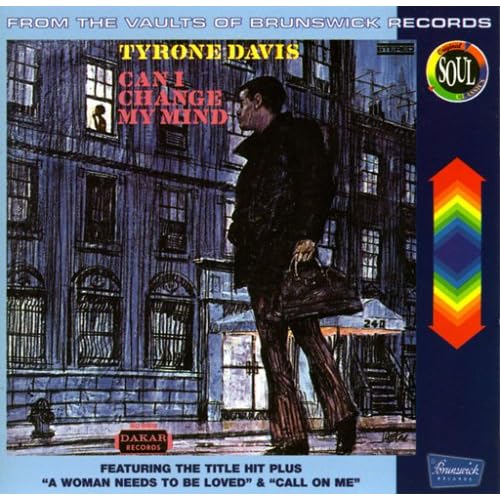 got this a few months back but it just keeps getting better. totally my serendipitous soul find of the year - and not from one of those collector-cheatin' rare-groove compilations i'm so ardently ambivalent about neither - just a budget-quality reissue i stumbled across in a random $2.99 bin in boulder. the whole album's sweet - "knock on wood" gets reinvented as a ballad, the arrangements throughout are consistently stellar, even when the songs sometimes dip below that mark - but it's plain to see why the title cut was the single, and apparently a respectable hit, though mostly lost to history, at least for folks like me.
it locks right off into a loping, almost mellow funk groove, with a nimble, rubbery bassline and chunks of guitar hittin' on the 2 so fat you could slice 'em - plus another guitar licking out effortlessly spidery spangles. and the horns - a single unison swell, repeated once up an octave, and then retreat, to make room for mr. davis' achingly langorous entrance on the vocal. the way he yawnily slides into that opening line - "...aaw, she didn't bat an eye" - is just priceless. ditto his smooth semi-crack on the word "time" at [1:14]. aw shucks. so gooey.
an intriguing premise too - it's nothing new under the soul sun for him to be lamenting his lapses that lost him his love, realizing it only too late - but the way he asks the title question, so innocently, as though he'd be doing her the favor, when clearly it's her mind that would need the changing. sly, kinda, but seductive. ooh, and check the reggae version by mr. mittoo, too.
marshall crenshaw - marshall crenshaw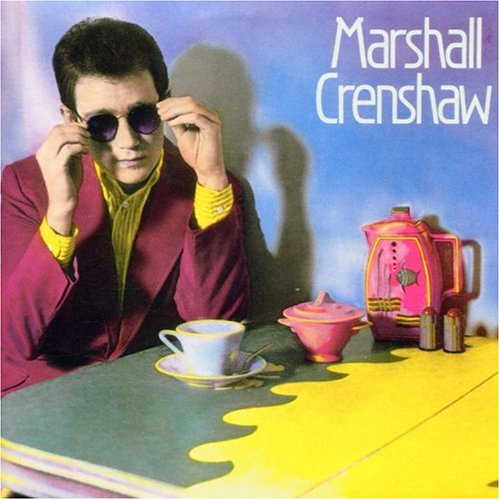 part of my ongoing campaign to get more comfortable or at least better acquainted with the [non-synthpop, non-talking heads] 1980s, partially sparked by my reading of this fascinating, smartly-written book, whose most substantial contribution to my understanding of the t-heads was a historical contextualization by means of occasionally interjected news-headline highlight reels, pop'n'politics anecdotage, and downtown-scene local color. also part of my ongoing campaign to get more familiar with more singer-songwriter types, if nothing else so that i can have more coherent things to say (and examples to give) in situations like that knotty wrangling with folk songwriting i was doing a few posts ago.
the same (the former, esp.) is true of the feelies [crazy rhythms, 1980] and aztec camera [high land, hard rain, 1983] albums i also picked up recently, and scritti politti before that - of that bunch, crenshaw is clearly the least post-punk (ergo least punk) and most songwriterly - not sure if he quite fits into the "new pop" rubric with which i'm haphazardly lumping the others, but whatever. i've known for a long time that i would like this - it's just been a question of whether i'd go with the readily available original release or hold out for the spennier rhino bonus-tracks reissue: i didn't. actually i don't think i really knew who he was until tara mentioned him, with vague disinterest, as somebody her dad liked - even though i feel like my dad might have one of his albums, maybe even this one.
right, so it's very obviously dad-rock - there was probably no disputing that even at the time - but let's not forget that it's still rock (it came out in 1982, the year of my birth - according to amg "a brief, exhilarating moment in between the fall of disco and the rise of MTV, when the eternal verities of real rock & roll broke through once again.") it reminds me, more than anything, of the likes of joe jackson and graham parker (and oh yeah robert gordon duh - elvis c. was never this prosaic), though not as punkily disaffected as either of them ("cynical girl"'s lyrics notwithstanding) - especially the way he talks about 'girls' (might as well spell it 'gurls') girls girls, walkin' down the street [q.v. "pretty girls," "local girls"], feels like a direct lineage from the beach boys and big star. is it just me or do people like this no longer get away with making reference to 'gurls' anymore in such a flip, factual manner?
anyhoo, peep it it pops. (obviously, btw, what this really is is power-pop, 'nuff said.) i couldn't choose a favorite track to single out for this - "rocking around in nyc" has one of the nicer unanticipated harmonic moves (the "...she's facing disaster" bit); the groovy "there she goes again" has been known to course through my head in the mornings, compelling me to put the album back on; "someday, someway" is a perfectly sensible single choice with swell harmonies - though in general i like the rootsy-cutesy rockabilly cuts less than the more straight-forward rockers (although honestly the best thing on here might be the cover of arthur alexander's "soldier of love," because that song is just so awesome and it's a pretty good cover.) which, ultimately, is kind of the problem - marshall crenshaw is a triumph of formalism, and everything on it shines with wholly admirable, consistent craftsmanship, but not with the spark of truly inspired, individuated songs-qua-songs. still craftsmanship is something - you certainly don't get it this good too often. remember, i like formalism.
[eta: if only marshall crenshaw were a brit (bloody sounds like one innit?) he would get some coolness points for being pub-rock, which is clearly what this is, except that it's american. nevermind that pub-rock is like the most dad-rock thing conceivable, it's still cool because it begat brinsley schwarz who nick lowe who begat elvis costello, or something like that. right? i need to investigate it more, but first somebody needs to make the early nick lowe albums available/affordable. obviously it should/would be yep roc, who are his current label and who just reissued robyn hitchcock's catalog and billy bragg's before that. ok?]
transient random-noise bursts with announcements - stereolab i don't have anything to say about the music on this yet, except that it's slightly underwhelming so far (tim sendra don't fail me now), but now that i've finally got it, which means i've now completed my collection of classic-era (i.e. pre-cobra) 'lab proper full lengths (groop's an ep rite?), which for a long time didn't really seem possible (though as it turns out there are only five)...i thought i'd be justified in asking a question that has always bothered me about this album:
is it "[transient random]-[noise bursts with announcements]"
or is it "transient [random-noise] bursts with announcements"?
i like the latter better, i think, as a theoretical description of music (that there would "random-noise bursts", which happened to be transient, as the primary feature, followed by the announcements.) but the former kind of seems more likely? can't tell.
as far as more current stuff goes, well i will admit that skye sweetnam's "music is my boyfriend" (awesome video too), roisin murphy's "overpowered" (ditto), lethal bizzle's "police on my back," britney spears' "heaven on earth" (yeah, "piece of me" too but that's old hat) and the veronicas' "untouched" all remain pretty righteous. but y'all knew that right?
as rumored, the bonus disc to they might be giants' the else, entitled cast your pod to the wind, is pretty phenomenal ("why did you grow a beard," "brain problem situation," "i'm your boyfriend now," "employee of the month" = future classics), though despite being fluffier and fresher, it'd be hard to say it's actually better than the album proper. which is also quite good by the way.
oh yeah, and did i mention that i rather like this devon sproule character?
12 March 2007
so, soul...
[or: "talkin' loud, sayin' nothing"]
one of the great things about soul music is there's not that much you can say about it. well that's not true. there's not much that needs to be said about it, maybe - at least anymore. or how about: whatever there is you might say about it, it's gonna pale mightily compared to what can be conveyed by the music itself. hm hm...well, better not try to talk about it too much, because you're gonna end up tripping over your words.
yeah, setting it up as anti-intellectual like this has this uncomfortably essentialist twinge, but...there's something there to do with its purpose, and its power, no? (soul has a massively complicated relationship with Otherness - on one level it's fundamentally antithetical to it - predicated on a universal commonality of emotion - but, at least in the current cultural/historical moment, it seems almost to be defined by its relation to an absent place and time - it can never be fully and unambiguously Present. so there's a lot to be said there, but little likelihood it'd help matters much.)
i guess it'll go without saying (see) that Soul is a superword, which more or less means it can't be defined (and don't ask me what a superword is, either - the best definition i can fully get my head around is something like "genre descriptor.") but, and this is maybe what i was (not) saying before - it's obvious when you hear it. i mean, we all know what soul sounds like (and so, we don't need to talk about that.) that's because, in part, it's a style with highly specified parameters. which might be another way of saying it all sounds the same. (which is true, i think - and i don't think that's a bad thing nor does it stop me from seeking out more and more of it.)
which, again, points to why there's not much to say about it. isn't it telling that i've gotten this far without mention any specific examples of artists or songs? i don't know whether that supports or undercuts (or both?) this little argument i'm having (with myself) - is it intellectual laziness on my part, or just endemic to the topic? it seems to me that when folks mention specific songs and artists in the context of a discussion of soul they're either using them as placeholders - arbitrary examples (and always the same ones too - aretha, marvin, otis, james) standing in for the genre as a whole - or something comparable but slightly more nuanced (as in the the fairly well rehearsed topic of regional stylistic differences, wherein the entire output of certain labels - stax, motown, philly international - are treated as more or less interchangeable and homogenous wholes.) or else they're getting really specific about the music (comparing the vocal approaches of different singers, for instance), which is sort of a different level of discussion from what i'm primarily concerned with here.
not that any of these things is bad, necessarily. i'm just making observations here.
so, i'm obligated (says me) to write about soul (as much as i'd really rather not) and/or specifically about
4 i got you babe Y etta james
which as everyone knows is actually a groundhog day song, and not a valentine's day song. but it's both a fun cover and pretty darn great in its own right, and besides i just had to choose any old soul song to represent the genre as a whole, and more or less any one would do, since they're all about love anyway. (well, i wanted one about happy love, which is always a taller order.)
seriously, etta's tell mama: the complete muscle shoals sessions, in addition to appealing to both the albumist and the completist in me [it's a genuine original album, plus over an album's worth of equally-stellar bonus tracks, and it's her entire muscle shoals output, as the title indicates, all on one cd] is perhaps the biggest revelation (so far) in my recent and ongoing soul binge. (a.k.a. building a reasonable proper library of the essentials.) i put it on s/r/s'd with elvis' get happy!! while stirrin' up some fry a while back, and it just blew me away... it's dynamic, fiery, fun, funny (check out "mother-in-law"), funky (even the ballads, somehow, not to say they're not heartfelt too), top-notch from start to finish: i would recommend it to anybody without hesitation. (anybody with an interest in soul music, that is - but who isn't these days?)
but i don't have much more to say about it - i couldn't really convey anything about what makes it great, but it would all become immediately apparent on listening to it - i'd be left musing about how so many of its tracks overlap with the (also awesome) clarence carter comp i got around the same time, and you just wouldn't be interested. is there something that makes this particular album so damn RFG, beyond the standard RFG-ness of vintage southern soul? maybe so, but it's probably nothing that mysterious, or at least nothing that could be mystified without a lot of painstaking attention to subtle detail. (you know: the songwriting, the singing, the arrangements, the playing. the remastering probably helps too.)
~~~~
hold on. just realized: i think i meant that there's not much to say about soul music in and of itself. but of course there are things to say about it, in contexts. and what seems relevant in particular is soul in the context of music, c. 2007. and specifically this notion that's floating around about soul revival(ism?) which is what my EMP proposal was about, of course. and, i did say that i would (or not) try to write about that stuff here since my paper wasn't accepted.
i noticed that not many of the papers that were accepted are about soul (there are a handful, but any fewer would really raise my eyebrows), and almost none (as far as i can tell/remember) of them have do with revivalism - certainly not soul revivalism. which is actually kind of surprising to me, because it's a perfect topic for the theme of the con, and an extremely timely one as well.
or has its time passed? - when there's a new york times sunday feature about it, does that mean the "pontificating about what's going on with all of this soul stuff" phenomenon has jumped the shark? no i don't really think so either. even though i am very late (it's my wont!) in getting around to mentioning it. pretty interesting article, though probably less for what it says than how it says it. here, have a link where you can actually read it. (thanks 'net!)
the first four or five grafs are nothing but a laundry list of different ways and places that soul has popping up in the cultural landscape of late (dreamgirls, james brown tributes, stax @ 50, candi, bettye, kanye, cat power, etc. etc.) i'd say lumping beyonce and mary j. blige (?) in with this still-rather-dubious "trend" is a bit of a stretch (on the basis of one sample on b's album?), but not as much gnarls barkley. (really now...not getting into it now, but i could if you like)
so, there's all of this stuff. but it's so disparate (and aimed at so many different groups of people) that it's hard to really call it a movement, or even a phenomenon. quoth craig werner: “It’s coming out of the hip-hop world. It’s coming out of the R&B world. You’re hearing it in pop music too. No matter which vector you’re following, you’re winding up with soul music.”
well ok. i'm not entirely convinced by this largely circumstantial evidence (or by the several paragraphs devoted to the alleged soul connections of current grammy-nominated songs and artists.) could it be enough just to say 'soul happens to be "in" these days' and leave it at that? (but in for whom? the demographics of the resurgence are still pretty mysterious to me: who's going to see bettye lavette; who's watching dreamgirls; who's listening to ghostface and cat power - are they all the same people, and if so are they conscious of these things being related?) there are all kinds of things going on all the time in cultureland, and it's easy enough to pick and choose where you're focusing... anyway, assuming this is a coherent phenomenon, is there any explanation for this sudden confluence? oh yeah.
three more quotes:
“People have been fed prefab music for so long that it’s starting to resonate with them that it’s not real” [Doyle Davis]okay, yuck. so here's where the article really gets my goat. setting aside (for a second) the kneejerk "prefab" headache...why does the emergence of one thing have to explained fundamentally in terms of the rejection of something else? can't soul music simply be great (and deservedly popular, if it is indeed actually "popular") without it being the more "real" and "authentic" alternative to some other music that must therefore be disparaged? [is "authentic" even allowed in the dictionary any more without scare quotes?]
“Electronica came along and gave soul to the machines, but now people are coming back and saying they want real soul played by real musicians,” Mr. [Matt] Abels said. “People want that smoky feel again.”
“People want something that sounds authentic, which I think to them means something that’s not being designed, something that’s not being distanced by advertising images or forced into a mode,” he [Werner again] said. “I hear that from my students all the time. They hate anything that sounds mechanical or processed. They feel like there’s an immediate response to experience in soul music. They hear it and say, ‘Yeah, that’s what’s adding the flavor to the hip-hop cuts.’ ”
does this explanation even make sense? people are giving up on electronica (which last i checked wasn't actually that popular in america - although i do like the notion of it being 'soul as played by machines') and mainstream pop (er, implicitly), and instead listening to, um, john legend (and christina aguilera)? how are dreamgirls and gnarls barkley and, sure, candi's astralwerks comeback and bettye's on anti- (oh man that label name is so fraught) not "designed" or complicated by advertising images? and i happen to know that not all of craig werner's students "hate anything that sounds mechanical or processed" - i'd wager most of them don't - because i heard one of them waxing rhapsodic about the pussy cat dolls and passionately arguing that britney and ashlee deserve the same props as the crystals and betty everett (hey charles, hit me up sometime!)
meanwhile, it's not just pop and electronica that's taking the fall here - the "experts" get in their smug indie digs too, on the weird and contentious grounds that rock and folk concerts are boring and lifeless, unlike soul performances (which have tended, historically speaking, to be polished, "sophisticated," revue-style affairs, putative rawly emotive content notwithstanding):
“People love the messiness of live music,” Mr. Werner said. “They love that sense that the players are actually listening to each other and that everything’s not all preplanned.”blech. well, i can attest to having danced with a giant grin at a sufjan show, right along with the dancing grinning cheerleading illinoisemakers on stage. eh, i don't think i'm going to dignify this obvious snidery with further response. (though i would definitely really like to see bettye's live show, which from the description in the article sounds a lot more exciting than her decidedly subdued album.)
For Mr. Davis, “It’s not the same as seeing the latest buzz-band rock band come and perform their album that just got a rave on Pitchfork.”
“You see the indie-rock kids who, if they were at the Sufjan Stevens or Iron & Wine show, would be completely reverent, stroking their beards or whatever, and here they are dancing with giant grins on their faces,” he continued. “I call those epiphanous musical moments. When you go see Bettye LaVette, you have that.”
okay, i get that these folks are just being typically shortsighted, prejudiced people, of the sort that are routinely considered reasonable, and i shouldn't hold them accountable for such commonplace snobbery. i also get that there's some relevant truth to their confused rhetoric - the "rejection" notion is a red herring, and it's not about a logical pattern of listening choices conforming to an easily discernable trend - i'd say it's not even about the sound of the music so much (remember, it's happening in a wide range of genres), but there is something about the soul impulse, as these folks lay it out - earnestness, humanity, passion, and sure, authenticity. which isn't too hard to link back to that whole death of irony business (can you believe it's been six and a half years? do you miss irony yet?) it just so happens that i find these qualities in plenty of pop and techno and indie rock - in fact, couldn't one say that these are things that most or all "good music" strives for? and soul just has an unfair advantage, being preternaturally predisposed to raw, emotional potency?
(which doesn't mean that you can access that potency just by sampling it or 'sonically alluding to it' [a lá gnarls, i guess], but you can try, and maybe fool some people - or you can at least remind them of soulfulness without actually achieving it.)
[at the end of the article, a Michael Gray offers a more concrete, less romanticized explanation for the trend: “What’s changed is what’s happening in the culture and the music industry. Platforms are being created to promote these artists.”]
interestingly, the article fails to mention the two artists that i consider to be doing the most exciting things with soul these days: sharon jones - whose concerts feel like actual small-scale revivals, in the old-timey religious sense - and jamie lidell, who's been more ambitious and successful than anyone i can think of at creating something truly new that still retains that evanescent soul impulse. i can see how jamie's steez is too actually musically innovative for the nytimes, but i'd say it's borderline inexcusable for them not to mention sharon/daptone at all.
a recent philly weekly article about the "giddy white men" phenomenon does mention sharon, in passing. (i'm guessing writer craig lindsay didn't draft that silly subtitle - the copy editors nabbed it from this line - "I eventually let my colleague borrow the album; I haven’t seen a white man that giddy about getting some soul in his life since David Bowie married Iman" - which is the second bowie marriage reference in two posts, for those keeping score.) mostly the article focuses on the wave of reissues from the likes of stones throw, ubiquity, numero group, and daptone, along with o-dubs' "soul sides" comp and the like - which is another aspect of the phenomenon that has a bit for relevance for me.
actually, it's been interesting trying to be a record collector/librarian with completist tendencies amidst all of this. with a new "undiscovered classic" being hyped and rediscovered seemingly every other week, one gets the sense that the soul canon is possibly in the midst of a shaking-up and reappraisal. time's gonna have to tell on that one - but it's possible that a few years down the line candi staton, for instance, will be seen as a more important and central figure than she was a few years back.
anyway, i've been trying to keep abreast of current reissues to some extent, but lately i've been more concerned with building a solid collection of the truly canonical stuff, both to have that frame of reference, and also because there's plenty of great stuff there that's not getting much attention these days. in fact, a number of the supposed greats (according to the likes of peter guralnick are still relatively underanthologized on cd) - especially the goldwax folks (james carr, o.v. wright.) i've been using the discography in the back of guralnick's book and, so far, mostly going with what's available cheaply through bmg and half (including a lot of rhino/atco reissues of stax and atlantic stuff.)
i've been held up actually reading the book because i wanted to more have the music in place to listen to alongside - i'd gotten as far as the sam cooke chapter and then paused, since i felt ray charles greatest hits cd wasn't enough to accompany the 50+ pages on him. but now that ray box set has finally arrived, so i'm ready to proceed. from there it'll be smooth sailing on into solomon burke and then stax and muscle shoals heydays...so i'll let you know how it goes.
18 February 2007
rudie got soul
 would you believe that these two men are actually the same size? one of them only looks taller because of the mystical transformative optical power of wisdom, music, and transcendental love.
 but i did have an idea about reggae recently, which is that it could be construed as a subcategory of r'n'b, and more specifically, as a form of soul music. considered this way, it suddenly becomes a lot more interesting to me. the direct impetus for this idea came from listening to this cd, which contains two of toots and the maytals' early '70s albums. i was familiar with some of the songs, especially "pressure drop" (which is mostly what made me decide i needed to own the albums), but i don't think i was prepared for the full magnitude of greatness on display here...it might be some of the most essential music i've ever heard. anyway i can't stop smiling whenever i put it on. it's reggae, but pretty hard to deny it's soul too.
so i've been trying to figure out what to do with this (hardly revolutionary, but still significant) connection. who else made music like this? bob marley, for instance, is fairly soulful, but his music never struck a chord with me in quite this way (though i should probably check out some of his earlier stuff.) i think i need somebody to explain what roots and rocksteady mean, exactly. (and bluebeat?) maybe wikipedia will do it. (hmm, sez that the maytals play "a unique, original combination of gospel, ska, soul, reggae, and rock"...well that's not helpful!)
 in the meantime, i'm checking out this album, widely and unanimously raved about as a classic, albeit one that almost nobody knew about for over two decades. at first i was underwhelmed, because it just sounded like typical, dubby reggae to me. (and, well, because it didn't sound very much like soul.) perhaps i should have expected as much - turns out i actually already had one of the tracks from it on the lee perry arkology box which i've intermittently enjoyed but probably never made it all the way through. upon repeated listens...i am growing to appreciate it more; there is some lovely subtlety to the production, and some of the songs are growing on me (that was probably the biggest disappointment on first listen.) it's clear that the primary emphasis here is not on pop song structures, memorable melodies, or emotional vocal performances (elements that i'm especially interested in these days, be they in '60s soul, '70s power-pop, and '00s dance-pop) - though there is, naturally, plenty of rhythm. of course, this is from 1977, by which time soul music itself had basically dried up, and/or developed into other things.
 more relevant to the issue at hand, though maybe something of an exploratory cul-de-sac, i've picked up this fantastic compilation. it demonstrates a very strong reggae-soul bond, to the extent that the music it contains - despite being the work of jamaican ex-pat musicians, is far more readily identifiable as funk and soul than as reggae.
7 i believe in music Y bob and wisdom
this track is a pretty good exampe - it's actually one of the three or four most reggae-like cuts on the cd, but what it most resembles is muscle-shoals-style gospel-soul. (there are only two tracks that i would call relatively straight reggae.)
it's also stunningly beautiful; both the musical performance and the lyrical message. it made me melt a little the first time i heard it (standing alone waiting for the subway.) i like having this message on valentine's day, because i think it's important for the holiday to be able to be about generalized, universal love, as well as just romantic love. interestingly, on the evidence of these three reasonably diverse cds, romantic and sexual love would seem to be a much less common topic for reggae than they are for soul, rock and pop. (i was considering including the deathly funky anti-war burner "love is the answer," by ram, instead of this one, but that will just have to wait...)
anyway, "music is love and love is music" is as good an explanation as any as to why ross is "of love."
and: "people who believe in music, they're the happiest people i've ever seen." 'nuff said.
23 January 2007
jazz and silence
how come nobody told me about the clipse ripping off (interpolating?) geggy tah? (oh, i guess that song isn't really on the album.) that's soooo adorably lame of them, i love it. of pharrell really, the nurd.
if you care, the sidebar mixylinks will be fixed soon - in the meantime, i got a hott new setup over @ mymymyspace, with an old-school player that i may just have to install over here as well.
well. well, the whole december-january accounting period is through, fairly enough, and we're fullspeedahead into a whole new thing, which is to say the presentfuture. january is high time to relax, and the entire music community, producers, consumers, and facilitators alike, aptly tends to take things pretty chill this month (even as the movie folks are amping up the apeshit), despite the strong lingering awareness of the annual cycle that we're headed inexorably back into.
this munificent pause in the new-music machine provides a good opportunity - if one can give up continuing to try to catch up on the previous year's muchados [this one's a no-brainer, but futuresex surely deserved a listspot...] - to listen to some old music. (i.e. more than 12 months old.) take last year, when i celebrated the return drive from new years' weekend by creating a mix cassette of '50s-'60s tunes i mostly hadn't really thought about in years. that was something of a jumpstart to a resurgent '60s pop and soul interest i maintained for the rest of the year, and still into now, as you'll have seen below.
so if that's the cycle, i'm coming back around and trying to scratch that little bit deeper this time - i'm not only reading guralnick's book, but trying to follow along with the discography - MR. ROSS O. LOVE just ordered some percy sledge, clarence carter, etta james, jackie wilson, jr. walker, and boxtops from BMG (durnit "multi-unit sets" no longer qualify for free selex, hence no w. pickett, b. bland, r. brown); and meanwhile i've managed to acquire most or all of the tracks on the "r&b: the transition year" segment of PG's dream discography of (pre-internet/reissue boom) hard-to-find classics. kind of miraculous that. so anyway, i'll have plenty to report on. (currently grooving hard on ivory joe hunter's "i almost lost my mind")
meanwhile there's still ample contemporary noisemaking going on: already this year - this week even - i've been to more concerts than i'd seen in the last month and a half of oh-six (well, i guess there was a reason for that). friday it was girl talk @ johnny brenda's, absolutely the most lovely venue i've ever had for waiting 2+ hours to get into a sold out show. so homey and communal, especially running into so many folks there. [hat-tip to the south orangutan crew, john (no relation i presume) the bouncer, (no longer) green-haired katie and friend (sister?), allie chav whom i saw on stage just as gg flipped lady sov, the other allie, and of course steadfast stoic stangoni]
i had something to say about the show in the comments box for this awesomely titled but rather glibly snarky article in stylus (thanks to bedbugs for the nudge - i see neither nick nor anyone else has elected to respond), and i may have more to say later, as i have another bone or two to pick with mr. sylvester. basically, it was everything i'd have expected and hoped for, even though greg didn't get naked. (best bit, hands-down: the guitar rockout from the end of "digital love" over a number of things but most notably "hustlin'", before it got sped up in a rather daft manner.)
the next night was the great and probably late sun destroyers at the tritone, their putative swansong, and easily their best live performance to date (and i would know, i saw all three!) seriously, i found it very affecting, and not just because my roommate's leaving town, or because i'd just had two beers and a jack'n'ginger, or even just because of the alienating and inescapably allegorical effect of the two bright (albeit soundless) TV screens playing goofy commercial outtakes and distracting much of the crowd from the (poorly lit) band on stage, but also because gabe writes some pretty heartbreakingly bleak and unhappy songs. good ones too - check out "bust my face" and especially "objects" at theirspace, though for the full pathos you'd need to hear "dictionary" (which has my favorite SD lyric - "i hold the belief/that i can achieve/more than i can") and the new song about leavings. hokay guys, now you've officially been blogged about. guess you can break up now.
before they played i djed, which was a last-minute surprise because whoever else was going to do it had backed out - thanks to jason painchiller, who organized the evening and also djed after the band's set (hey, that's a pritty nice mix he's got on hisspace too. yay, lovefest@oursspaces!) it's a monthly do (named after probably my favorite fall song too, unless it's "spoilt victorian child") and looks likely i'll stay involved, possibly even help author it into something bigger dancier and more drawful. anyway, i enjoyed my surprise set, which jumped from mostly instrumental funk to a bit of microsomething, and then re-explored a number of choice moments from ¡OhSiX!, with alterations of course. "robot song" worked real nice with whatever i played it into. somehow abba slipped in there too.
and all of a sudden i've got all these other dj gigs coming up - one this friday, then three in february and another two in march (that's counting the mascher monthly, but not further t-t-t-tritone action.) so if you're in philly, you've got no excuse; if not, c'mon and visit! and/or get me to come play your town (i'd like to work on light-travelling laptop gigging capabilities, with the goal being a party in seattle EMP weekend.)
of course, there's really never a total lull in the media cycle. soon as i finish this i'm heading out to pick up the "new" (to you?) shins and of montreal records - in an attempt to demonstrate that downloading doesn't actually hurt record sales, the theory being
that even though i've now actually confirmed that i like both enough to own them eventually, i would have likely bought them on or near the day of release if i hadn't already heard them. something like that. maybe i'll even snag the the good the bad and the queen, which i actually am genuinely excited about, and i need to not let danger mouse make me forget that i'm not allowed to be party to the general damon albarn ambivalence, especially when nasty people are suggesting (rather counterintuitively) that his whole problem is not being able to move past blur. (since when did it become okay to talk about blur like they were uncool? you'd never get away with that about pulp.)
and while i'm at it i'm also gonna pick up some of montreal tickets (because, whoa!) though probably not ylt, not yet. looking forward too to jonada richman, maybe some of the other johnny b's shows, and ... the whole david byrne/fatboy slim/imelda marcos/carnegie hall thing (how can one resist?)
the title of this post, in case you were curious, refers to yet two more forms of sound-preoccupation that are presently forthcoming in this new year of newness. the jazz courtesy of this cat, a publicist for blue note (among others) who's been hooking me up with many more-or-less "modern" records to explore (more or less jazz too - hopefully he's also about to help me out in my soulquest with some sweet stax and specialty sides), getting me unexpectedly pumped up about jazz, and may or may not end up being my neighbor very soon. this-all does bode well for me actually getting back into jazz in the 007, as i've imagined i would sooner or later (free jazz even?) should be some good gristle there. [as side-note - who knows when i'll get around to (mod-)cunchry, but i have been listening to the new keith urban album, randomly, on the basis of thom jurek's perhaps rightly glowing recommendation.] i better hold off for now and save discussing actual music for a future post(s).
as for the silence...looks like that may be one of the few downsides to the brand-spankin'-new (job) i'm about to commence (!)...or who knows, maybe it'll be a blessing in disguise. hey, i could get into silence.
to bed with history
this was my proposal for EMP:
Sharon Jones was born fifty years ago - in James Brown's hometown, as she's fond of mentioning - but she didn't put out her debut album until five years ago. That record and its 2005 follow-up - both released on Brooklyn-based, musician-run Daptone records and recorded with that label's younger, mostly white house band, the Dap-Kings - consist of gritty, funky, rawly emotive Soul, of the sort that Jones was surely surrounded by growing up, but that has been strikingly scarce since the mid-'70s.it didn't get accepted. (sigh...) oh well. neither did dave's, which i thought would (also) have been a fabulous paper - but both of us are probably still going to attend. at this point i'm really curious and excited to read the abstracts for the proposals that did get accepted.
With their vintage-stylized album artwork and choreographed "super soul revue" concerts, Jones and her labelmates might strike some as "retro" novelty performers or niche-based nostalgia-mongers. But the honesty and artistic integrity of their music defies such facile categorization: this is, undeniably, living and contemporary music, albeit music with strong roots in tradition.
Aside from producing emotionally viable art (and fresh sample-fodder for the likes of Kanye West), how is the Daptone stable relevant to the current musical landscape? Despite inklings of resurgent interest, via reissues, feted comebacks, and newly emergent would-be revivalists, Soul still feels Old, inextricably shackled to its historical originary moment. In an age when decades-old genres from garage-rock to synth-pop, substantially liberated from their historical referents, can enjoy renewed artistic and commercial viability, what is it about Soul that sustains its rarified, ossified, antiquated air?
In considering this question, I'd like to examine Jones and her contemporaries in terms of the stylistic parameters of Soul, the historiography of R&B (including the debatable merits of the '90s neo-soul "renaissance"), the effect of changing performance conventions, production techniques and audience-reception models, and those ever-thorny issues of purity and authenticity, to glean what I can about the music's past, present and future.
although it would be nice to think that i might still work on writing something formal and/or in-depth about the topics i raised there...well, who knows, maybe i will, but i'll start by trying to blog about them in some vaguely systematic way. or not.
i've been reading peter guralnick's evidently canonical sweet soul music: rhythm and blues and the southern dream of freedom, which i had figured would be necessary background for my paper, but is also something i possibly should have read years ago. i'm already slightly skeptical about guralnick because of something charles hughes said at EMP last year, part of the incredibly intense q+a session after the girl groups panel that i think i never actually got around to blogging about, in response to xgau's insistence that he "name names" about who he was attacking in his polemical paper (which i'd really like to get my hands on a copy of...i'll try asking him again) arguing that modern female pop acts are equivalent (and deserving comparable appreciation) to "classic"-era girl groups.
what i took from that is that guralnick may be something of a curmudgeon and a rockist (or soulist or whatever), which i suppose isn't an especially relevant concern in terms of a book whose scope is explicitly limited to the 1960s. though i'll keep it in mind as i go. so far i have read the introduction, which seems to do a good job of revealing and grounding his biases (as a listener and lifelong fan, but also an admitted outsider to the history he's reporting on, with a number of preconceptions that he'd to a greater or lesser extent debunked since starting his research.)
the introduction also nicely corroborates my conception (which i didn't have space to elaborate on in my proposal) of the short span and decisive endpoint of Soul:
"Soul music was a brief flowering, really. It first peered out in the mid-1950s, like rock'n'roll, as a kind of alternative to assimilation. It came into its own no earlier than 1960, crossed over by 1965 or 1966, and, despite lingering traces of its influence throughout the culture, was spent as a controlling force by the early '70s." [18]
he also offers a convincing depiction (presumably to be strengthened by the actual content of the book) of soul as the unique product of unique [historical, social, cultural, economic, geographic, etc.] circumstances. perhaps less helpfully for my project - or not, since it's helpful to have something to argue against, if that's even what i would to do - he asserts more or less outright that a popular rediscovery or even a stylistic return or would be impossible, because of the unrepeatable conjunction of those circumstances, and particularly because of the unlikely way in which artists who were in some ways "naive," or at least treading in uncharted waters, were able to achieve phenomenal commercial and popular success:
"I've tried to view it...as a combination...of art and commerce in which the music attained its highest level when the marriage was closest and in the absense of which the form cannot be revived today." [p. 19]
(also: "Soul music...was the product of a particular time and place that one would not want to see repeated, the bitter fruit of segregation, transformed...into a statement of warmth and affirmation" [p. 3])
actually, i agree with him; history of course can't be repeated, and an authentic "revival of the form" is unimaginable. and it's hard to conceive of what a "real" soul revival would look like in the contemporary music milieu (even though in some ways it seems like it might be happening) (would it be like the swing and ska "crazes" of the 1990s? - more on those later...) is it possible to distinguish a "true" stylistic revival from a more general return to relevance that would take some other form?
there's a central problem though, and this is where the (alleged) allegations of guralnick's curmudgeonliness come into play: to him "it almost goes without saying that soul was an incomparably greater form (because it was incomparably more passionate, emotionally expressive and individualistic) than its more celebrated contemporaries" [i.e. motown and the beatles...and also, i think implicitly though maybe i'm reading too much into it, greater than any other pop music that's come along since.]
in some ways i'm tempted to agree again, because there is something incredibly powerful and emotionally expressive about southern soul music, which doesn't necessarily make it "greater" than less nakedly emotional pop or rock, for instance, but does seem extremely special. but if the essence of that music is now gone forever, does that mean that degree of expressiveness married to that level of artistry is destined to remain the province of this one brief historical moment, never to be recaptured or equalled?
it seems clear that that's an unacceptable conclusion. and not an especially hard one to poke holes in. but it's still a tempting trap to fall into, and one that seems to be manifested and reinforced by the mythologizing tendencies that prevail in the discourse surrounding soul music.
02 October 2006
john and sharon: live and in person


01. in d.c. this weekend, i got the chance to see and hear two of my favorite performers: the mountain goats and sharon jones and the dap-kings. in both cases, a total treat. the latter was particularly lovely; not only was the concert free and outside (on the terrace in the back of the kennedy center), i hadn't known it was happening until the night before.
and sharon sounded better than ever. her singing was at its most dynamic and technically impressive; it seemed like her vocal chops have improved in the months since i've seen her. and the band - tight as ever, of course - appeared more comfortable on stage; binky griptite's emceeing was more commanding, the horn section choreography less put-on, and the interplay between sharon and individual band-members - in a spotlighting series of solos that i think was a new addition to the show as i'd seen it - more substantial and touching. despite her weirdly formal pale green pants-suit, sharon's characteristic playfulness and uninhibited pre-song banter (the first thing she told us was that she loses her mind when she gets on stage) won over the demographically mixed and potentially awkward haute-d.c. crowd of mostly daptone neophytes right away. (the incongruous and futile six-count swing dance lesson before the show hadn't made matters easier.) still no sign of "N.B.L." or "all over again" in the live show, but that's a drag i've come to expect by now, and there were several promising new songs that were almost as exciting. oh yeah, and her dance breakdowns on "there was a time" (ooh, checkit) and the bit about her ancestors are as awesome as ever.
as for the mountain goats, they're riding the wave of their growing popularity (a sold out show at the black cat, definitely the largest venue i've seen them at save the pitch4kfest) with typically casual aplomb. which is to say the show wasn't appreciably different from the intimate set i saw at haverford last year (not different, in "mode", let's say, except that that show was many times more special and awesome, partly because of its intimacy.) the setlist drew about equally from sunset tree and get lonely, reminding me how much i like the former ("lion's tooth"! "love love love"! ...as if i needed reminding) and gently enhancing my positive take on the latter, either in spite or because of its lyrical cohesiveness-bordering-on-monotony. (i liked how he introduced "moon over goldsboro" as a song about a guy who walks to the gas station and wishes he could keep walking, but ends up having to walk home.) a couple of older selections too, though nothing older or more potent than "baboon" from the coroner's gambit (a treat) - and an excellent new song (key chorus line: "hold onto your dreams 'til someone beats them out of you.") the set was cut short (i'm pretty sure) by the glitchy twofer of a sound snafu (no guitar in the house) and a broken string. but they pulled through (rather than dealing with these issues) with a bass-and-vocals only closer and encore, including "best houseguest" or whatever that franklin bruno song is called, and an audience sing-and-flip-off-along to "no children."
2. this was my seventh time seeing the mountain goats and my third time seeing sharon. i'd wager you can't see musicians that many times (or else you don't - and certainly not thrice in one year!) without developing the sense of a "personal" relationship with them that affects how you experience their concerts and (perhaps to a lesser extent) records. it's hard to characterize, but it definitely adds a dimension to the "typical" artist-listener relationship, and i imagine it has a lot more to do with why people like going to live concerts than the straightforward pleasure of watching music be created.
i started off by calling sharon jones and the mountain goats two of my favorite performers, but i have to say it feels incongruous to leave that as an unqualified description, and particularly that something rubs me a little funny about using that word to describe john darnielle. and that's the thing i'd like to tussle out a minute here.
3. darnielle (who still, effectively, is the mountain goats) presents himself as an ordinary guy. i hesitate even to say "presents," but you've gotta know that anything that happens on stage, particularly if it happens night after night for years (and seven times in my presence) is some sort of presentation, just as much as 19th century realist fiction involves construction and artifice, as i've spent three hours every recent wednesday being made to realize despite spending [1000 pages in three weeks times ~20 pages per hour averages to] roughly seventeen hours a week (!) allowing tolstoy to try to delude me otherwise. so darnielle's performance mode is "unaffected" - he gets up there, plays songs on his guitar, talks to the audience (or to himself, or to peter) in a witty but off-the-cuff manner that one gathers is not dissimilar to the way he speaks in everyday life (except insofar as he probably doesn't spend much time in everyday life introducing songs), responds to things people in the crowd say, and sometimes acknowledges the artificiality of the concert setting and an awareness of the broader context (for instance, before playing the new song he suggested he'd prefer for people in the audience not to post the song on the internet right away.) that's about it.
"the dap-tone super-soul revue" on the other hand - which apparently is the title of every sharon jones concert even if the "revue" part merely consists of the band playing a number or two (with binky singing) before "the brightest star in the dap-tone universe" takes the stage - is obviously a very different, and much more complex, kind of presentation. one could of course talk about the mountain goats show in terms of costuming, set composition, pre-planned routines to accompany songs (parts where peter sings back-up on a line, for instance), and the deliberate creation of a persona - and it would be a mistake to assume that john and peter don't put thought into these things, even though they don't call attention to them in the way the dap-kings certainly do. but it's perhaps more interesting to consider the more overt ways in which their performance styles are similar (and different) and how these affect their relationship with the audience.
4. for one thing, both concerts have a similar type of predictable conventionality: without having seen either performer before, i could have told you which parts of each show were "standard" (that is, which ones happen at every SJ or MGs concert) and which were unique to that evening. in the goats' case, it's easy to predict (correctly) that the setlist varies from night to night, with some songs turning up at a majority of shows and others only making rare appearances - a traditional approach for singer-songwriters attempting to balance the desires of a "cult" following and newer fans hoping to hear the "hits" - and that the "banter" is effectively different at every show, but that the basic format is fixed and unchanging. at the dap-tone revue, it's possible to distinguish sharon's off-the-cuff banter from the more "scripted" (or at least standardized) patter which probably makes up at least 60% of her talking on stage. and the complexity of concert-going conventions require that we on some level "suspend disbelief" and pretend that her extended monologues-cum-dance-demonstration routines are completely impromptu, something special she's deciding to share with us on this lucky night, even though it's obvious they aren't.
of course, in both cases, this conventionality is only "predictable" with a large amount of cultural conditioning about how to interpret these performances in context - and i can't really speak to how someone with a different set of cultural expectations would understand these concerts. there are definitely concerts and performers that willfully attempt to defy conventional expectations or else at least engage with in novel ways (although eventually every "experimental" performance styles develops its own conventions) but these two are notably standardized modes - folk/singer-songwriter performance and funk/soul revue - that are drawing on well-established traditions.
5. in sharon's case, the relationship with historical tradition is an especially pertinent consideration. everything about daptone records - the music, the stage shows, the visual aesthetic, the preoccupation with LPs and 45s, etc. etc. - is based on (or should i say "taken from"? their website says "channels the spirit of") the culture of soul music in the mid- to late 1960s. this is overt - or, well, obvious - but not quite explicit in the sense that, for example, there is nothing in the "daptone revue" show that says this kind of music and presentation is not standard practice in 2006. it's presented neither as nostalgia (though it could certainly serve as such for the appropriate audience members) nor as "retro" revivalism, but, straight-facedly, as living and contemporary music, albeit music with strong roots in tradition. i would say this choice of presentation is exceptionally canny, since it neither limits nor presupposes their audience (thereby allowing their appeal to range broadly, without the assurance of a given target market), although describing it as a "choice" raises issues as thorny as those it addresses. it's worth noting that daptone is an artist-owned and -run independent label, a manifestly self-propelling and, one imagines, somewhat communal organization whose labor-of-love ethos does wonders for the sense of authenticity purveyed by the music. and authenticity, predictably, is one of the largest issues at stake in all of this.
one significant factor i have yet to mention is the unique position of sharon herself: born in 1956 (i was at her 50th!) in augusta, georgia, she wasn't quite old enough to have been a performer in the "original soul era" (or whatever), but she was sure old enough to have been around for it, which affords her a free pass beyond the quagmire of authenticity issues that plague james hunter, for instance - a young and british musician working in a similarly "spirit-channelling" vein. it's even to her credit that she wasn't a known figure in the old days (she did some back-up singing in the '70s, but didn't record under her own name until the late '90s), since she can't be a "comeback" (read: nostalgia) artist like candi staton; also, even at fifty she's got plenty enough youthful spark to convey the adolescent excitement of classic soul along with its "mature" aspect.
[there's a lot to say here...and i'm getting off the immediate topic of this post...but i've just realized that i'd really like to and ought to think and write more about daptone, and then propose to deliver a paper about it at next year's EMP! fits in perfectly with the theme of history, time and place.]
[EDIT: another thing to think about: sharon and agency/authenticity w/r/t ashlee/paris/et. al., considering her songs are all written/arranged/produced by bosco mann. who's also the bandleader, even though he never says anything on stage, just hides behind his big shades. looking vaguely sinister: like a spector/svengali. she acknowledged him at this show - saying that whenever anything's going on in her life she tells bosco and he writes a song about it - which i hadn't her do before.]
i have no problem whatsoever accepting sharon jones and the dap-kings as fully legitimate, authentic (proviso caveat) and (even!) relevant musicians. actually, it's almost weird to feel it necessary to state that, but i can easily imagine someone taking a different view (seeing them as "nostalgic," "novelty," "niche," or whatever.) and - to get back on track - i'd attribute a good chunk of this willingness to my having seen her now three times, to the relationship we've developed (i mean, even apart from bringing her flowers and being pulled on stage to dance with her) and my investment in and awareness of her as a person. put another way, when you've actually seen a band and recognize them as "just people"/artists trying to make it - even though their onstage presentation belies that image (because they act like they're the biggest stars in the world playing at the apollo) - it fosters an artist-to-audience/community relationship that's decidedly different from the cultural-phenomenon-to-consumer-of-culture relationship. whew. (i'm not sure i want to privelege and valorize the live concert experience the way i seem to be doing here: it's not necessarily so that a concert will change one's relationship with the performer in the manner i'm describing; furthermore there are other ways of that change occuring, including just by listening to the records.)
6. i said a while ago that john darnielle presents himself as an ordinary guy. that's not quite right: he presents himself as "himself." or just as himself (maybe). in any case, he's quite clearly not an ordinary guy. except for being white, male, having a guitar around his neck and writing songs about relationships between men and women. (all of which is more than enough to relegate him to rockist purgatory in case somebody wants to make this into a post about rockism, which i don't really feel like touching.) alyssa once said that being a mountain goats fan is about liking (or at least being interested in?) john darnielle himself, which i think is very true in a way it's maybe hard to see with respect to even other similar artists (i'd have to think about this more thoug - i do see some parallels with dylan, especially q.v. the dylanology essay in best music writing 2002.) given that, the live show is an especially significant locus of the fandom experience, the opportunity to encounter the goathead (?)
more specifically, the live show simultaneously furthers and, in moments, seems to diffuse the mystification that i see as central to the mountain goats' appeal - that is, the tension between fiction and lived reality in darnielle's songwriting. to what extent are john's songs autobiographical versus purely fictional? are they based on emotions and situations that he's experienced, but with details reinvented or obscured? these questions are hard to ask about most of his lyrics, as elliptical as they tend to be, and to be honest they aren't especially relevant to enjoying his work - the flawed logic of "guy with guitar => confessional songriter" trope has been plenty dismantled elsewhere. still, i can't help but wonder, in the wake of two widely-hailed "autobiographical" (but still markedly abstruse) albums and a third that sure feels starkly confessional but flies in the face of the fact of his happy marriage - unless it's a tortured and album-long revisitation of a past breakup(s) in which case i wonder what lalitree's thinking - where, exactly, is john in all of this.
plus, if goats-fanboy = darnielle-spotter, there are tantalizing glimpses of the carefully-selectively-hidden man himself that come in his confessional song introductions (i reckon maybe two or three per show are revealing in some way - his banter at the haverford show last year significantly changed my understanding of the sunset tree, and even if there's something distasteful in the smack of "detective work" i'm sort of surprised there isn't more of an online community devoted to exchanging such "clues") and even in the emotionally charged delivery of certain lines. there may not be much "content" conveyed in his passionate delivery, but the unmistakable intensity (his forceful whisper, his removed glasses, his clenched face and taut, raised palm, his open mouth and its 'silent shout') confirms the emotional resonance of songs whose lyrics only hint at the possibility of great emotion. i love the way he seems to inhabit each of his songs as he performs it; the sense that he is re-living (even the fictional?) scenarios whose essence they capture. that way that, although their substance may remain ineffable, their impact is unmistakably there in that moment, and if you're there, you can share the moment with him too.
key example of this at the black cat show: he introduced "baboon" with the repeated mantra, "hope it never happens to you" - solemnly proferring the wisdom that, though we can't know another's hopes, he hopes we share with him the hope, that "it" never happens to us or to anyone else, hope it doesn't. the song is wonderfully intense, as performed there and on album, and although the lyrics are hopelessly elusive about what's actually happening, darnielle's spoken prologue attests to the gravity of its horror, and affirms the underlying sense that even his most impenetrable songs are about something deeply real to him.
7. john darnielle's mystery is that he's an ordinary-looking, overly articulate, jovial and wisecracking but - it sometimes seems - also painfully introverted, bespectacled, place-name-obsessed boxing fan and classics geek who has the ability to craft marvelously concise and - if you surrender to them - hauntingly poetic songs about the emotional experience of contemporary life and relationships. sharon jones' mystery is that she makes soul music not only vital and relevant, but personally meaningful as a contemporary individual. these mysteries - not all that mysterious, perhaps, but entrancing nevertheless - are at their most pronounced in these artists' respective live performances, where they are, in turn, perpetuated, complicated, investigated, rendered insignificant, debunked, reenacted, and never, we hope, quite resolved... but that's why you gotta go back and see them again.
