
2010...2010... (oh sorry, i was just quoting cornelius.) i love 2010! just a few weeks late: my album reviews from the first three months of this amazing year. in the order they currently appear on my hotly-contested best of 2010 list (except the bottom five or so, which are not making any kinda list of mine...): Alphabeat: The Beat Is... review
When the pristine power pop of Alphabeat's eponymous domestic debut was buffed up and made over into the even shinier, synthier version of itself that became their gleamingly fluorescent international debut (retitled This Is Alphabeat), it sure seemed like the Danish sextet had hit some kind of insurmountable limit, an ultimate pinnacle of pure pop that just couldn't get any brighter or peppier. That turned out not to be the case, however: The Beat Is... (which, like its predecessor, sports a different title from its Danish counterpart, The Spell, as well as a marginally revised track sequence) is an even glossier, more unabashedly poptastic affair than their first album. Continuing in the overtly dancy direction signaled by the tracks added to their debut's re-release (in particular "Touch Me Touching You") and the popular Pete Hammond remix of "Boyfriend," and slightly updating the band's oh-so-'80s touchstones, Beat takes its cues from turn of the '90s club music: Hi-NRG, Euro-beat, hip-house, and the Scandinavian synth-reggae of Ace of Base. Leading the way is a clutch of undeniable floor-fillers boasting just about every era-appropriate production trick imaginable: the chunky piano riffs and Styrofoam string hits of the instantly infectious "The Spell" (a better, sleeker leadoff than the rather quizzical, vocoder-heavy title track), the filtered rush and gleefully superfluous turntable scratches of "DJ," the swelling snares and kinetic popcorn synths of "Heatwave" -- all of them colossal earworms that also happen to showcase Stine Bramsen's impressively gritty, soulful house-diva vocals. There's nothing remotely approaching a ballad -- the darkly dramatic "Heart Failure" comes closest to the moody fare that slightly sank the latter half of their debut, but even that features a bumptious disco beat -- but the album does mellow a bit for the winningly slinky "Q&A" and "Chess" (which earns points for an unusual if clunky lyrical conceit and a genuinely playful arrangement featuring timpani, marimbas, and amusingly adulterated vocals). While the stylistic dictates of this material may have made Alphabeat's songwriting a bit more simplistic this time out (not that their earlier work was exactly overflowing with structural complexity), their knack for melodic hooks is as sharp as ever. Some listeners may pine for the less streamlined, less electronic, arguably more personable style of their debut, which after all peddled a distinctly different shade of retro-pop nostalgia, but those willing to move with the times (or rather, the 20-year revival cycle) will agree that the 'Beat have crafted another winner. Malachai: bio and Ugly Side of Love review
There may indeed be nothing new under the sun, but the cunningly crafty Bristol duo Malachai have hit on some fairly novel and idiosyncratic ways of reinvigorating the sounds of bygone days, while drawing their proudly retrogressive sonic cues from a surprisingly under-plundered patch of the pop-history dustbin. Ugly Side of Love is a rambunctious pastiche of classic British AOR, circa 1968-1973 -- a pastiche in the sense of unabashed stylistic mimicry -- steeped deep in the grooves of psychedelic and progressive rock, sunny power pop, high-octane blues, gritty white boy soul, and even early metal -- as well as a motley and often muddled hodge-podge, structurally and sonically. Unlike other nostalgia-fueled, sample-driven aural patchwork quilts, however -- the Go! Team's Thunder, Lightning, Strike and Jason Forrest's Unrelenting Songs of the 1979 Post Disco Crash are both useful reference points, although this album isn't anywhere near as giddily hyperactive -- this album presents Malachai less as cheeky post-everything ironists than as grinning but largely reverent revivalists, playing things surprisingly straight-faced behind their monkey masks. Even if their purposely murky working methods are clearly a good deal removed from your typical '70s psych-blues outfit, Ugly Side of Love would sound shockingly plausible if presented as a newly rediscovered artifact from four decades past. Virtually every sound here, including all sorts of rudimentary electronic manipulations -- backwards tape loops, vocal phasing, cavernous reverb, vinyl scratches, rhythmically slipshod looped drum breaks -- could conceivably have been heard on any number of the era's trippier platters, and apart from a couple of credited and/or recognizable sourcings (the Guess Who's "Hand Me Down Love" forms the basis for "How Long," and, apparently, a loop of sunny soft popster Daniel Boone powers the blisteringly righteous stomper "Snowflake"), it's confoundingly hard to tell how much of the album is composed of samples, even if Malachai are sometimes downright sloppy about leaving audible seams. Indeed, the ramshackle quality of the production is entirely in keeping with the loose, quasi-analog aesthetic, and given the psychedelic excesses of the period, the album's formal oddities (brief, inscrutable interludes; barely there song structures; one-off stylistic cul-de-sacs like the peppy beach-party strum-along "Moonsurfin'" or the gloom-soaked, Geoff Barrow-assisted lysergic dirge "Only for You") might not be so out of place either. As refreshing and intriguing as it is on a sonic level, though, Ugly Side of Love might remain no more than a curiosity if not for its copious, pervasive musicality: abundantly funky boogie rock grooves, broiling guitar licks, and subtle but deep-penetrating melodic hooks that, with repeated listens, threaten to strong arm even ear-candy confections like "Lay Down Stay Down" (with its propulsive, Can-like drumming and mariachi trumpets), thanks in large part to the compelling and versatile vocals of frontman Gee, whose grittily powerful pipes are uncannily well-suited to this particular stylistic potpourri, switching off handily between honeyed ("Another Sun"), menacing ("Blackbird"), and earnestly soulful ("Fading World.") Heady stuff, indeed. Eluvium: The Beat Is... review
For an artist whose primary emotional touchstones are stillness and serenity, Matthew Cooper refuses to stay in one place for very long. Right from the start, the ambient composer/producer has taken a departure, slight or striking, with each new release, seemingly making an exercise of finding continually new and different approaches to similar emotional terrain. Similes, Cooper's fifth full-length as Eluvium, and his first since 2007's sumptuous, symphonic Copia (discounting the like-minded, limited-release “solo album” issued under his birth name in 2008), is no exception: it's his first foray incorporating percussion and vocals. Hopefully that news hasn't prompted any undue consternation among the Eluvium faithful, though, because this is hardly the shift into beat-driven pop that some might have feared (or, for that matter, anticipated.) The “percussion” takes the form of soft, gentle clicks and pops (and a few distant, barely there thuds) which appear on about half of the album and bear only a casual resemblance to “beats” in the standard sense (save perhaps for “The Motion Makes Me Last,” whose soft, insistent pulse does indeed create a stirring, quietly exuberant sense of motion beneath the prevailing calm.) The vocals, though nearly as unobtrusive and relatively sparse (three of the eight cuts are instrumental), are a striking, almost magical development -– longtime listeners may find the emergence of Cooper’s voice after so many years to be particularly affecting and even revelatory, although it’s as understated an instrument as we might have expected all along: a sober, pensive, near-monotone, whose Ian Curtis echoes are tempered by the baritone richness and introspective, bruised-heart resonance of Lou Barlow and Bill Callahan. Cooper’s cerebrally abstract, insightful way with language, meanwhile, has long been evident in his well-turned if rather fussy song and album titles. Those qualities are certainly present in his lyrics, but hearing him intone his own words renders them somehow less ponderous, more yearning and introspective, and gently, wittily self-aware, especially since many of the lyrics here feel like glosses (similes, perhaps?) for the ineffable, absorbingly ruminative experience of listening to Eluvium’s music, or the perhaps not dissimilar sensation of creating it. And that experience has never been more absorbing, ineffable, or rewarding than it is here. Despite its innovations, Similes is firmly grounded in the ambient compositional techniques that Cooper has spent his career mastering. Copia’s lush, variegated organic textures, Accidental Memory in the Case of Death's tenderly tinkling pianos (albeit more heavily processed and ring-modulated than ever before), and even the softly whirring guitars of Lambent Material all turn up here, but the best reference point is the invitingly warm, expansive drones of Talk Amongst the Trees (whose title is referenced in one of this album’s first lyrics) which up until now was arguably Cooper’s zenith. With Similes, he’s made his most touching, certainly his most engaging work to date, and against the odds, somehow the most quintessentially Eluvium release yet. jj: Nº 3 review
The gentle waves of buzz surrounding JJ's curious marvel of a debut quickly lapped beyond the duo's native Gothenburg shores, creating considerable expectations for its follow-up, released jointly -- a mere nine months after JJ Nº 2 made its initial splash -- by Sweden's Sincerely Yours and landlocked Amerindie bulwark Secretly Canadian. Thus aptly adjectivally equipped, JJ Nº 3 takes few chances, very much offering more of the same from these sincerely secretive Swedes: it's virtually identical to its predecessor in titling strategy, length (nine songs in a fleeting 27 minutes), and sound. That sound -- lush, glassy, placidly grooving electronic indie pop with wispy tropical and new age undercurrents -- counts for a lot, and those won over by Nº 2's surreally syrupy vibe (equal parts childlike sweetness and narcotic haze), or by Elin Kastlander's lusciously lazy vocals, will find themselves woozily wooed once again. But listeners craving a bit more substance may find it a bit of a bum trip; songwise, Nº 3 falls sadly, decidedly short of its counterpart's dizzying highs. The opener, a spare, somber piano-and-vocals cover of the Game's "My Life" (more specifically, Lil Wayne's chorus hook) is oddly, bluesily effective, but it still feels like an arch, inscrutable goof (particularly given the unmissably cheeky interpolation of ATC's "Around the World") -- either way, it's easily the most incongruous and attention-getting thing here, and once you get past it the rest of the album just sort of drifts by. "And Now" sets the familiar, understated tone, and is a quiet highlight; "Let Go" is better, a wistful, breezily escapist daydream complete with lyrical references to beaches, suntans, and heroin. "Voi Parlate, Lo Gioco" suffers from a nagging similarity to Nº 2's "Masterplan," but it does offer a lovely moment of lyrical self-reference "when the music stops...then the music drops." Otherwise, there's plenty of sonic seductiveness to get lost in; there's just not a whole lot to hold on to -- a partial (but hardly crushing) letdown from an outfit that was previously firing hard on all fronts. Whether the dip in quality is the result of a rush to create new material or whether these are simply the lesser leftovers from the same sessions that produced Nº 2, here's hoping JJ take some time (and maybe one of those epically blissful vacations their music conjures so evocatively) to make sure Nº 4 comes out fully baked. Tindersticks: Falling Down A Mountain review
Eighteen years, and still they soldier on... After a somewhat revised version of Tindersticks broke their five-year recording silence with 2008's The Hungry Saw, it took less than two years for the group (again with a few modifications to the lineup) to compound that successful return with another new album -- their eighth overall -- which stands as perhaps even more of an achievement and pleasant surprise than its very fine predecessor. While Saw offered a few rare glimmers of positivity and sweetness from Stuart Staples and company, it was essentially business as usual for the perennially moody Britons. Falling Down a Mountain isn't exactly a major reinvention, either, but it does back up the golden-hued sky gracing its cover with some of their most upbeat and optimistic songs to date (keep in mind those are relative terms), and a liberal extension of the looseness they've been gradually settling into since 1999's Simple Pleasure. The six-and-a-half minute title track is immediately striking, with its simmering, asymmetrical, jazzy groove buoying a hypnotically simple vocal riff and some uninhibited soloing from trumpeter Terry Edwards. "Harmony Around My Table" is a bouncy soul-pop number that might hardly be recognizable as Tindersticks if not for Staples' inimitable quavering baritone (as always, an acquired taste, like fine wine), while the low-key lovers' duet "Peanuts" sports a charmingly simple, slightly silly lyric, and the twinkling ballad "Keep You Beautiful," though a typically mellow affair, is uncharacteristically, almost achingly sweet. Elsewhere, the album takes on a vaguely Western tinge (again echoing the dusty cover landscape), with the galloping, lustful "She Rode Me Down," Edwards' lonesome flügelhorn on the Morricone-esque instrumental "Hubbard Hills," and the gritty, downright driving "Black Smoke." Eventually -- this being Tindersticks, after all -- the darkness does creep in: the deceptively buoyant "No Place So Alone" seethes with the jealousy of a jilted lover, and by the penultimate "Factory Girls," we find Staples brooding alone, doused in melancholy, feebly asserting that "it's the wine that makes me sad, not the love I never had." It's a typically mournful, typically lovely Tindersticks moment, made all the more exquisite here in contrast to the increased stylistic range that came before it. Sometimes, it just takes a slight change in scenery to help you appreciate what you've always had. Pantha Du Prince: Black Noise review
Since his second full-length as Pantha du Prince, 2007's truly sublime, duly acclaimed This Bliss, Henrik Weber has gradually expanded his profile beyond the traditional confines of the minimal electronic realm, turning in remixes for the likes of Animal Collective, Bloc Party, and the Long Blondes and, in 2009, making the surprising shift from Hamburg's Dial Records to venerable indie rock label Rough Trade, hardly an imprint known for its electronica output. Black Noise, his first album for Rough Trade, bolsters those indie credentials further with a couple of guest spots: !!!'s Tyler Pope plays bass on one cut, and Noah Lennox (Panda Bear, Animal Collective) sings on another. "Why stick to the things that I've already tried?," Lennox muses in his drippy, hazily harmonized fashion on the typically lovely "Stick to My Side" -- and indeed, why shouldn't we expect Weber to branch out a bit? As it happens, though, Lenox's vocals are about the extent of the overt musical innovation on offer here. (For what its worth, Pope's bass on "The Splendour" fails to leave any impression, although the track manages to acquit itself of its rather aggrandizing title quite nicely.) Partisans of the Pantha of old needn't be too concerned (and, by the same token, those intrigued by the possibilities of a more indie-infused Pantha record may be disappointed) because Black Noise does overwhelmingly stick to the tried and true. Which is hardly a cause for complaint. Weber is truly a master of mood and texture, one of few techno/minimal/microhouse producers working with an unmistakable signature sound, and all of his hallmarks are present and accounted for: the shimmering chimes and bells, muffled clicks, woozily atmospheric synth, and deep, dubby bass, set against sturdy but subdued pulsing house grooves, all of which make his music, almost uncannily, equally well-suited to dancefloors and dreamscapes. He has a few slight sonic twists up his sleeve -- "Abglanz" introduces a figure played on what sounds like a steel drum, and "Behind the Stars" brings on the grinding electro keyboards and dark, distorted vocals, recalling the "micro-goth" tag sometimes applied to his earlier work, while the brief, beatless "Im Bann" is all languid guitar strums, thick hypnotic haze, and a muffled crunching sound like footsteps in the snow -- but nothing here would have sounded out of place on This Bliss, and a few tracks, like "Bohemian Forest," whose melodic twinklings feel a bit like Pantha-by-numbers here, could well have been standouts on that record. With its generally well-conceived but vaguely non-committal-feeling gestures toward expanding Pantha du Prince's musical range, Black Noise can't help but feel ever so slightly like a letdown after the consistently mesmerizing rapture of its predecessor. But make no mistake: Weber is still making some of the most enchanting electronica out there, and if this album brings him the increased exposure for which he seems well-poised, there are few producers more deserving. Bonobo: Black Sands review
Laid-back London groove maestro Simon Green (alias Bonobo) returns after a considerable absence (on the recording front, at least) with this fourth full-length helping of his masterfully mellow monkey magic. While it's not terribly divergent from the future-jazz cut-ups that made his earlier efforts such an instinctively natural fit with the turn-of-the-century Ninja Tune stable, Black Sands evidences a clear evolution into a more distinctive, sophisticated, and complex style, resulting in his most musically adventurous work to date, and certainly his most modern-sounding. Green's clearly been keeping his ear to the ground for a bit of rhythmic reinvigoration: the immediately striking "Kiara" reworks the hauntingly elegant string refrain that opens the album with submerged vocal splices and a halting, head-nodding left-field hip-hop beat á la relative Ninja Tune newcomer Flying Lotus, while cuts like the "Eyesdown" and "All in Forms" shade subtly toward the dubstep diaspora. Elsewhere, "We Could Forever" is a funky Afro-Latin workout riding an infectiously crisp guitar riff, and the scruffy, swing-inflected breakbeats that dominated Bonobo's earlier output crop up again on "Kong" and "El Toro." But while the grooves here serve quite nicely (and keep things consistently varied), it's the lush layers of unmistakably live instrumentation laid on top — most of it played by Green himself — that make the album really soar. That's especially true on the two closing cuts, both stretching toward seven minutes, which eschew electronics almost entirely and feel more than anything like dense, moody, compositionally intricate modern jazz. At the other end of Black Sands' polychromatic though tonally consistent spectrum are a clutch of cuts featuring the rather blandly breezy vocals of Andreya Triana — silky smooth electro-samba ("Wonder When") and neo-soul ("The Keeper") that make for more than passable mood fodder but can't quite match the musical inventiveness displayed elsewhere (though Green does weave her vocals quite deftly among the clustered woodwinds and sparse stutter-step of "Eyesdown.") For a style of electronica (chillout/downtempo) that's grown decidedly dusty over the past decade — even though Bonobo is clearly striving to move well beyond such staid genre divisions, and in many ways succeeding, that's probably still the best place to slot him if you gotta — Black Sands is a welcome infusion of life and warmth. Nneka: Concrete Jungle review
Concrete Jungle, a compilation of tracks from Nneka's first two European albums — eight are taken from 2008's No Longer at Ease; four from her 2005 debut Victim of Truth —serves as her introduction to American audiences. The child of a Nigerian (Igbo) father and a German mother who divides her time between Hamburg and Lagos, but takes most of her musical inspiration from American hip-hop and soul (and Jamaican reggae), Nneka comes across perhaps all too readily as an emblematic figure, an embodiment of certain familiar Pan-African tropes. Her compelling personal story seems to encapsulate many of the complexities and contradictions of African diasporic history, while her heterogeneous mix of funk, reggae, rap, R&B, Afro-beat, and pop feels like textbook culture-fusing eclecticism. The cover of Concrete Jungle seems designed to cast the singer as a sort of rainbow-hued "Mama Africa," superimposing her solemn face with a multi-colored map of the continent, curiously mislabeled with American state names (although it does downplay her impressively expansive afro.) It's an attractive reading and an apt persona, and Nneka does it some justice, although it obscures the extent to which she's a unique artist drawing on a singular set of life experiences which don't fit into a pat, familiar narrative. Still, the ambitious array of styles here does make it hard to put a finger on Nneka's distinct identity. There is a palpable (decidedly old-school) hip-hop undercurrent throughout, despite the lack of any traditionally styled boom-bap beats, and even though Nneka really only flexes her (entirely respectable) rap skills on two cuts (the somewhat gritty "Showin' Love" and the bombastic, rock guitar-fueled "Focus" ), "Africans" and "Kangpe" both offer fairly straight-ahead reggae vibes — authentically roots-flavored and mildly updated, respectively — but beyond that, the grooves are truly all over the map: "Uncomfortable Truth" is a horn-heavy 6/8 funk shuffle; "From Africa 2 U" is bubbly highlife-styled Afro-pop; "Walking" and "God of Mercy" nod towards Massive Attack's soulful brand of trip-hop; "Come with Me" is a bluesy acoustic number that calls to mind Tracy Chapman; "Heartbeat" (a 2009 Top 20 hit in the U.K.) is a tense, modern pop confection with buzzing strings and hyperactive double-time drums. On paper it sounds like a disjointed mess, even if there are certainly interconnections linking most of these styles, but somehow Nneka (along with her primary musical collaborator and producer, DJ Farhot) manage to make these disparate tracks succeed not only individually, but as a generally cohesive whole. Among the common elements tying it all together — apart from Nneka's slightly grainy voice, which is thin but versatile and potent — are a consistently organic sound palette (there are almost no overtly electronic elements), and a frequent political edge that's galvanizing without being aggressively militant, and remains uplifting while rarely lapsing into platitudes. Comparisons to the adventurous, populist neo-soul divas of the '90s — in particular Erykah Badu and Lauryn Hill — are both inevitable and absolutely warranted, which helps explain why Nneka's music sounds so refreshingly out of step: just about nobody (not even the revitalized Badu) is making music in this vein anymore with this level of intelligence, warmth, and accessibility.
----- Fredrik: Trilogi review
Trilogi, Fredrik's second full-length outing, is so named because its contents were originally issued as a series of the three limited-edition EPs, self-released by the band on 3" CDs with handmade origami packaging. Despite some flowery language in the accompanying press release about "contemporized viewpoints of the Lovecraftian dream passage," the knowledge that this music was at one point presented in three discrete installments in no way alters the effect of hearing it as a single 50-minute whole -- there are no appreciable musical distinctions to be made between the three segments, which were all recorded in the same six-month span. However, the image of those few delicate, distinctive objects that were initially created to hold these songs does resonate nicely with the particular character of Fredrik's music: intimate, tactile, small in scope, and lovingly crafted with careful attention to detail. These qualities, which made their debut album, Na Na Ni, such a charming and unassuming surprise, are very much still present on Trilogi, which treads similarly evocative sonic territory, blending a cornucopia of organic musical (and non-musical) sounds with sparse electronic touches to create a creaky, ancient-sounding, surreal sort of folk music. This time, though, the tone is notably darker -- right from the eerie, mildly menacing opening notes of "Vinterbarn" -- and the songs, while typically gorgeous and affecting sonically, aren't quite as memorable. It's hard to put a finger on what exactly has shifted, but the deft balance between melody and atmosphere that Fredrik achieved so exquisitely their first time out is not quite as compelling here, with only the uplifting, quietly anthemic "Flax" standing out as a clear highlight. Daedelus: Righteous Fists of Harmony review
Though Daedelus has never been one to follow any path but his own, his output over the years has traced a clear if gradual trajectory toward more overtly beat-driven and pop-oriented (or, at least, vocal-inclined) material. In that sense, Righteous Fists of Harmony – a mini-album released on Flying Lotus' Brainfeeder imprint – marks an abrupt retreat, a sharp departure from the candy-coated dance party of 2008's Love To Make Music To. In fact, it's closer to the gently wistful sepia-toned IDM of his 2002 debut, Invention, than virtually anything he's issued since. Longtime fans will appreciate the return to the familiar, distinctive timbral palette of his early releases; a lush, musty blend of organic elements (bass clarinet, flute, classical guitar, and creakily treacly strings – employed to especially dreamy effect on cinema-scope closer "Fin de Siécle") with electronics (reedy synths, muddled-up programmed percussion) that somehow feel just as fusty and antediluvian. True to his nature, Daedelus hasn't just gone about exhuming the sounds of the past (his own and otherwise) without a well-thought-out reason for doing so: Fists is a concept album, themed broadly around the modernist struggle between technology and imagination (which might have come across more strikingly if Daedelus' juxtaposition of organic and electronic sounds weren't so habitual and effortlessly fluid) but more specifically around the illustrative example of China's turn-of-the-20th-century Boxer Uprising, wherein a band of martial artists, believing themselves to have magical powers, rose up against British imperial rule only to be crushed by technologically advanced weaponry (the album's marvelous title is a translation of Boxers' name for themselves). It's not too hard to hear these ideas playing out in the music, over half of which is instrumental: Daedelus has no problem conjuring up a suitably nostalgic, wanly hopeful air or the sense of a distant historical setting (though it's too bad he didn't take the opportunity to experiment with Chinese instrumentation). "The Finishing of A Thing," in particular, is unmistakably programmatic, its measured, stately fanfare summarily swallowed in a chaotic surge of speed and sound. Three highly subdued vocal cuts don't necessarily augment the concept – "Order of the Golden Dawn" (named for a contemporaneous but unrelated British mystical society) finds Laura Darlington (the producer's wife and Daedelus/Flying Lotus vocal mainstay) sleepily intoning the words "Boxer Rebellion" – but they hardly disrupt the mood. While it may not rank among Daedelus' grandest or most musically distinctive works, Fists is a typically satisfying treatment of an inspired, intriguing premise. Josiah Wolf: Jet Lag review
Josiah Wolf is in a bad way. The drummer/multi-instrumentalist for indie pop-hop, odd-jobs Why? -- and brother of head Why? guy Yoni Wolf -- penned this debut album in the evidently rocky wake of an 11-year relationship, which makes it a solo effort in more ways than one. The lone Wolf also played every note of these lonely, vibe-heavy arrangements, which aren't a far cry from the textural warmth and inventiveness of his work with Why?, but trend toward more simple, if not necessarily sparse, downcast chamber folk. "The Trailer and the Truck" kicks things off with a bit of gusto -- its familiar loping marimba figure and dreamy synth pads offset by rapid-fire drums in martial, measured spurts -- but things stay pretty mellow from there on out, leaving the focus squarely on Josiah's often fragile vocals, which bear a clear familial resemblance to his brother's gruffly personable speak-singing. And that's a fine place for the focus to be: Josiah isn't quite as flashy a wordsmith as his notoriously loquacious sibling, but his more plain-spoken (if still poetic) style can be quite potent, particularly at its most unfiltered and direct. Jet Lag is unambiguously a break-up (well, post-break-up) record, through and through, with plenty of emotionally blunt appraisals of that situation ("Unused 'I love you's build up in my throat/And my apartment smells like divorce," "For eleven years, we didn't touch another/and now I can't sleep") that cut to the core. But Wolf also finds more interesting ways to explore his heartache than simply wallowing in it -- sifting through memories both fondly distant ("That Kind of Man") and bitterly fresh ("The New Car"); grappling with eternity in the shower on "Master Cleanse (California)"; struggling internally to move forward on "The Opposite of Breathing" -- that favorably recall his brother's intimately honest anecdotal approach. Yes, the shadow of his other band, and specifically of his (incidentally, younger) brother, may be hard to escape when hearing and contemplating this album -- the stylistic similarities are pretty undeniable, and not necessarily to Josiah's advantage -- but the elder Wolf has enough of a distinct voice (and enough to say with it) that Why?'s fans will definitely want to give it a listen -- and those who find Yoni a bit too dizzyingly cerebral might take more kindly to Josiah's sincerity and directness. The Bundles: The Bundles review
Jeffrey Lewis and Kimya Dawson can both boast back catalogs full of smart, funny, insightful, and touchingly direct punky folk tunes, but they've also each penned plenty of inane, inscrutable, and/or indulgently scrappy song-doodles that, at best, have served to flesh out each performer's personably idiosyncratic, warts-and-all appeal. The dividing line between these two types of songs is a subjective one, to be sure, but even devoted fans would probably agree that the bulk of The Bundles -- the first recorded output from a longstanding though intermittent collaboration between these two leading lights of anti-folk -- lands sadly but squarely in the latter category. From the shambling start of "A Common Chorus," with Dawson repeating "Don't forget about your friends" over crudely basic Casio and acoustic guitar bits, the album sets up an emphatically informal tone that ostensibly speaks to its low-key, friendly inclusiveness (to wit: minutes later, after a bunch of rambling overlapped vocals and a unison throwaway Hollies reference, the Dawson-led Olympia Free Choir pop up to sing the song's title en masse), but more often winds up feeling impenetrably haphazard, or merely lackadaisical and tossed-off. To its credit, The Bundles does play like a true collaboration, with the marquee twosome along with the band's other members (Lewis' bass-playing brother Jack and drummer Anders Griffin, and engineer/fifth Bundle Karl Blau) trading lines or simply singing simultaneously, and the fun they clearly had putting it together can't help but be a bit infectious. Lewis, in particular, spews prodigious strings of would-be witty absurdist wordplay, sung-spoken sham poetry, and non sequitur nonsense rhymes ("Shamrock Glamrock") that are chuckle-worthy when they're not utterly asinine. A few numbers are mildly musically compelling -- the gently melodic "In the Beginning," the Western-flavored travelog "Desert Bundles" -- and "Metal Mouth"'s bizarro ode to brace-face love is a decently inspired conceptual coup. But only one moment here resembles the big-hearted, unflinchingly personal straight talk of Lewis and Dawson's best work: midway through "Over the Moon" -- shortly after a bit of claptrap about "squirrel beards" -- Dawson issues a brief, singsongy defense of her anti-materialistic value system, culminating in a mantra that stands as the album's clear statement of purpose: "I just wanna sing with my friends." A laudable goal, sure, but hardly a surefire recipe for listenability. If the results are as witless as the hokey, painfully screeched parable "Ishalicious," these Bundles may be best left unwrapped. Everybody Was In The French Resistance...Now!: Fixin' the Charts, Vol. 1 review
Right from the get-go --with the brilliantly meta "Formed a Band" -- Art Brut's Eddie Argos has been obsessed with (and excelled about) writing songs about pop music, a preoccupation that's only become more pronounced with each of the group's albums. So it's hardly surprising that his first major venture outside of the band is a conceptual project of pop songs inspired by other pop songs. Specifically, Fixin' the Charts is an album of answer songs -- a long-standing pop institution (from "Roll with Me Henry" to "Roxanne's Revenge" to "Lloyd, I'm Ready to Be Heartbroken"), but one that's probably never been indulged to quite this extent. Here, we get to hear the other side of some familiar pop stories: a response to Martha & the Vandellas' "Jimmy Mack," the perspective of Michael Jackson's long-lost bastard son (q.v. "Billie Jean"), and a rebuttal to that would-be boy-stealer Avril Lavigne, which flips "Girlfriend"'s bratty cheerleader breakdown on its head ("he won't stray/so go away") and throws in a fitting, side-long allusion to Argos touchstone Jonathan Richman. Sometimes, the "answer" is a bit more oblique: "Creeque Allies," whose refrain provides the rather unwieldy name of this outfit, is quite literally a history of the WWII French Resistance movement, with no apparent connection to the Mamas and the Papas' "Creeque Alley," aside from a vague lyrical cadence and a rambling narrative style. In general, though, the re-imaginings are both witty and spot-on, down to anachronistic but entirely in-character details like the lovers of "Scarborough Fair" stalking each other on Facebook, and the Crystals' "Rebel" "handing out fliers for his electro night." Though they're obviously comical in intent -- if you thought Art Brut were a novelty act, there's certainly no escaping it here -- these aren't precisely parodies. For one thing, Argos and his partner-in-crime Dyan Valdés don't simply reuse the tunes of the songs they're skewering (admittedly, Argos can rarely be accused of using "tunes" at all); but instead create new musical settings that vaguely approximate the feel of the originals, sometimes to rather strange effect. Indeed, the album's skewed musical decisions can be just as much fun as the lyrical foolery: "Hey! It's Jimmy Mack" is a pleasantly amateurish pastiche not of Motown, but Phil Spector-style girl groups, complete with sleigh bells, handclaps, and swirling strings, and "Billie's Genes" warps Jacko's nimble pop into a kind of lumpen quasi-funk with some spirited synth trumpets, while "Superglue," a fairly direct counter proposal to Elastica's "Vaseline," glosses the original's punkish snarl into something that sounds closer to Stereolab (and maybe just a touch like "She Don't Use Jelly"), and the self-explanatory Dylan-response "Think Twice (It's Not Alright") is set to hesitant harpsichord and Valdés' nicely harmonized vocals. Still, Fixin' the Charts really comes down to the jokes and the concept -- how much you appreciate it will depend on how much the idea appeals to you in the first place, and how well you can tolerate Argos' sung/spoken/ranted vocal approach, but it's definitely good for at least a chuckle.
21 April 2010
AMG review round-up, volume XIX: 2010 first quarter


23 February 2010
signs of livestock: feb '10
my show-going's been slow-going for a minute – been doing a fair amount of preview coverage for cp, but, until last week, hadn't really managed to see much live music at all this year.
[though that's discounting the obvious live musical highlight of the year so far, the 69 love songs cover party (that link leads to PW, the sworn enemy, but there are some pretty nice pix there - check the skeptical stair-sitters in #16) masterminded by sam and adam, which was a righteous blast. i got to sing three of my faves too: "i think i need a new heart," "long-forgotten fairy tale," and "busby berkeley dreams," plus impromptu group vox on "i'm sorry i love you." it only took us around four hours to get through, by my count, 57 out of the 69 – no "two kinds of people," alas – pretty damn freaking awesome.]
otherwise, i was foiled in attempts to see nneka and tape because of the snow (the former i just couldn't convince myself or anyone else to brave the blizz for; the latter was canceled but i didn't realize that until i'd trudged all the way there, listening to the utterly lovely new eluvium flutter all over me with the flakes), and to see la roux (about whom i wrote a "one track mind" that didn't even make it to the web, or not yet at least) due to crazy incomprehensible booking/cancellation/rebooking shenanigans (ok, technically i could have gone to see her/them/whatevs at the roxxy nightclub "shred your ex" party on valentine's friday, but $20 cover + 1:00am set time + dubious delaware ave setting are a pretty rough sell, even for me.) and i missed pink skull and memory tapes too, though i particularly enjoyed blurbing the latter.
ok, but: did see the shy, pseudonymous swedish mope sisters (kinda like the musical moron twins), taken by trees and el perro del mar (not actual sisters, but sisters from another mister), on a valen'sdate. not sure why it took me so long to realize (and it wasn't necessarily extra great shakes live), but that taken album (east of eden – should have taken a hint from it being named after my quasi-favorite book) is really pretty lovely stuff, and quite upfront and accessible too (as opposed to the somewhat floaty and indistinct love is not pop, which i do also like quite a bit, but is difficult to even grasp onto enough to really love.) sarah a. is, however, a more interesting presence than victoria b. she's kinda weird in fact. looks like this:

better: saw british retro-pop goofball v.v. brown, who has been making significant inroads on my heart, at the somewhat unpromising (but potentially up-and-coming as a half-decent west-of-the-schuylkil venue? hm...) marbar.
 she didn't have a parasol, or lighting that was at all decent; she was wearing what she describes as "geisha hat" that hid her hair and to some extent her face, and lit from below by a frantic color-flashing light (once they rigged it up, about halfway into the set) that did cool and disorienting things to her plaid pants. this felt like a very silly show – there were only maybe twenty people in the crowd, for one thing – but she was loving it, bubbly, alternately endearing for her giddy showmanship and her enthusiastically genuine personability – anyway completely lovable. she seemed just tickled to be here, her first time in philly, asked us what she should do (i wish i knew how to answer that question... somebody shouted out "standard tap" and then explained that they had "pub food," which made her just light up, and ask if she could get a good cup of english tea anywhere) and seemed almost as surprised that we didn't respond with unbridled enthusiasm when she asked about drake (before turning in a kick-ass cover of "best i ever had" – "i thought you loved hip-hop in philadelphia!?") as she was that we had come there to see her and actually knew her songs (she was going to skip "crying blood," but made the mistake of mentioning it and then the crowd wouldn't let her not do it – complete with a reggae "remix" recap.) she opened with my current fave "everybody" (sung thru a megaphone) and closed with "shark in the water," what an undeniable feel-good hit, don't know how i was so tentative about it at first...
and, last night, i faced the rains and trains to see nosaj thing and daedelus (and jogger too, but i only ended up catching the last two numbers of their unwieldy drill'n'bass/screamo/psych/folk/glitch-pop/whatever weirdness....guess i'll puzzle that out later.) it was the "magical properties tour (check out this v. awesome poster), a celebration of daedelus' new label, which doesn't seem to be very well organized as far as having any sort of web presence, or any actual releases, current or future, apart from the jogger debut and even that only barely seems to exist (if it makes it into the amg database, it'll only be thanks to my persistent nagging), but good on them putting the tour together, good idea, good work.
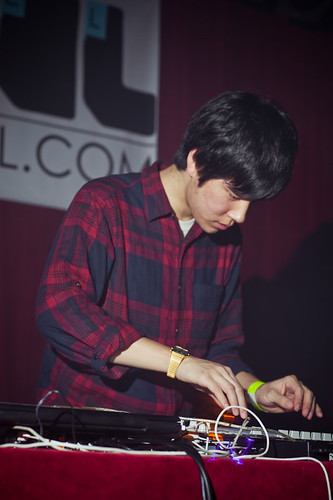 nosaj (whose name seems to be pronounced somewhat differently by his various friends/tourmates) was unbelievably sick. and slick. he played mostly his own music, including the bulk of drift, but with copious amounts of live tweaking and twiddling, amping it up with a brilliant sense of dancefloor pacing, and moving fluidly and almost imperceptibly from one track to the next, occasionally slipping in some other nuggets by the likes of busta rhymes, portishead ("wandering star"), wu tang, flying lotus (i think?), and what must have been zapp (or possibly dâm-funk...need to get my ears on that.) all pretty excellent to move to (better if i hadn't been clutching my coat under my arm) but the best part might have been just watching young mr. thing, aka jason chung (who was wearing a similar if not the same plaid button-down as in this picture, and snazzy-looking watch), as he tended to his knobs and sampler pads with a nonchalant precision, making understated but palpably pleasurable effect-twisting wrist-flicks with off-hand grace. sweet sweet.
alfred daedelus darlington weisberg-roberts was up next and last. strange sort of feeling to be seeing him in the flesh, this funny little fellow who's done so much to charm me over the past decade, through his distinctly unique presentation (visual and verbal as well as musical) as much as anything – with his records too, for sure (invention and, particularly, of snowdonia), though somewhat troublingly less so starting around 2006's denies the days demise. i can't quite put my finger on what's changed in my appreciation for his music (even as my amg compatriots continue to rave over it) – sure, his style has developed in some identifiable ways, but i'm not quite sure why it doesn't do it for me as much now.
it is nice that he seems to have more friends to play with now. for a long time it felt like he seemed sort of off in his own world; occasionally setting-up slightly incongruous rendezvous with the cali undie rap world, anticon and ilk (q.v. the weather), but mostly content (and at his best) as a lone operator. but these days he's (apparently) something of a linchpin of a bona-fide scene, even an elder-statesmen of sorts, perhaps, and now with his own label to boot. (again, apparently.) well. his introductory statement to the crowd, made some flusteredly, was rather touching: "i just want to let you know, if you don't already, that everybody who's up here really means it...terribly so."
 he announced that he'd play "some fun stuff and then some dirty stuff and then back to fun stuff." "what's the difference" someone shouted, and he smiled meek assent, but in fact i couldn't really figure out what he meant, as his set felt relatively consistent in tone throughout, building fairly quickly to a level of activity that, while fun for a while and intermittently, mostly felt closer to dirty – in the messy sense, and not the fun one. he was using the monome...his monome – actually, two of them, one smaller one (which he only picked up occasionally and rotated around to make the LEDs all slide to one side and the sound go all squelchy) and the big 256-button one, which he had angled toward us (like in the picture, though he wasn't quite so snazzily dressed last night.) it was certainly mesmerizing to watch him dance his fingers around the grid, and try to figure out all the sequences he was setting in motion.
frankly, though, the music coming out of the speakers just got to be too much to handle. it felt sort of like an especially unhinged girl talk set, except that only a small fraction of the samples were recognizable. stylistically it was all over the place, though heavily electronic, but ranging from dubstep to disco to hip-hop to synth-cheese to doo-wop to soul. i'm pretty sure there was a beirut song in there, one of the few instances of the polyrhythmic juxtapositions (a 6/8 strum pattern against the steady 4/4) that make some of his early productions so tantalizing. i only recognized a handful of his own tracks (i haven't spent all that much time with his latest, love to make music to, but i would have expected to know more from that if nothing else), though he did drop in one of my very favorites, "something bells," butting it up against some early stevie wonder (was it "uptight"? can't remember now), but it left before the real climax.
eh, it was at least interesting, for a while, and maybe it would have been more fun if i'd been dancing more (though, i did try and couldn't really get into it), but on the whole it felt like the (admittedly very cool) technical aspects of using the monome as a performance tool were getting in the way of the musicality that's been so pivotal in his past work. oh well...

