Had some adventures today. Having fun, getting into the zone. Saw about twice as many bands as Thursday, too. Unintentionally apropos lyric quote of the day, from New Build: "It's not good for the body, but it's good for the soul." (At least, I hope that's true.)
 esc
esc
(this is not spoek mothambo, it's just some guy who was at the spin party)
Spoek Mothambo 12:30 PM SPIN Party @ Stubbs
A friend hooked us up with passes to the hot-ticket Spin Magazine party, killer lineup but also an ideal, archetypal way to start a Southby day: free BBQ, free beer, free vodka, free weirdo space-age sugar-water. The highly amusing MC for the event ("Make some muthafucking tweets!") described this Sub Pop-signed South African rapper/artist/guy as "way cooler than you," which I guess is true on a technical level – and he did have a pretty fly jacket – but between us I think you're actually probably cooler. His set bounced around from post-punk to rap to electro-ish breaks in rather haphazard fashion, and was decent to dance to in spurts, but didn't leave much of a musical impression, except maybe his funked-up version of Joy Division's "She's Lost Control."


Dionnevox 1:00 PM @ Stubbs
From Seattle, playing this party because they won some sort of contest, but anyway they earned it, without a doubt. Nothing short of baroque in their approach to costuming, with a sort of dark fantasy steampunk burlesque look (summarized by the aforementioned MC as "if the movie Blade Runner were two attractive girls.") Lead singer lady stripped through about four distinct outfits over the course of the brief set, including a sequined harlequin bustier and black leather bodysuit with assorted diagonal zippers (she had to sit down on stage to fully remove that one), not to mention her elaborately made-up/bejeweled face and black feathered headpiece, while the dead-eyed dancer was equally striking in black and white lace tights, garter, striped faux-fur legwarmers and platforms. For some reason they didn't make the DJ/producer guys dress up at all; totally lame. Musically they followed a similar aesthetic – dark industrial electro-goth torch songs with low, deadpan vocals and solid songwriting. The standout was probably "Spoken Like a Slave," during which the singer lady repeatedly cracked her mic cord like a whip.

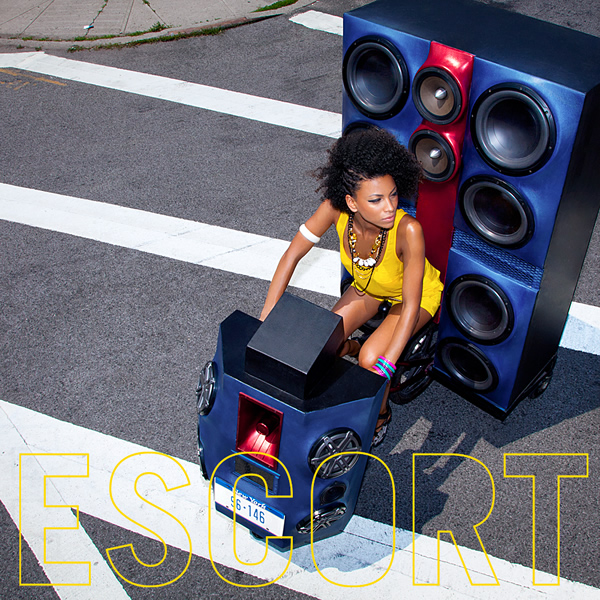
Escort 1:30 PM @ Stubbs
Stone killers. Escort is a fifteen-piece (at this show anyway) disco orchestra, largely composed of NYC studio pros (the drummer happens to be my cousin.) And they're perhaps the most ridiculously tight live act anywhere, not to mention the most fun. They're fronted by lanky French-African singer Adeline Michele, who's a total knockout and a sweet-smiling charmer – but really the whole band are just gorgeous to look at; about as diverse a collection of musicians as you could imagine sharing one stage. Too bad they're apparently too big a band to make touring economically plausible; there's a lot of folks out there who could use some of their pure, unadultered joy.
New Build 2:10 PM MWTX @ 1100 Warehouse
The latest in a recent string of unreasonably excellent Hot Chip side projects (following Alexis Taylor's About Group and Joe Goddard's 2 Bears – who just put out probably the party album of the decade), this group is spearheaded by guitarist Al Doyle (also of LCD Soundsystem) and drummer (in this group, bassist) Felix Martin, joined here by a Stop Making Sense-ish full band, including a killer timbale/steel pan player. With his shock of red hair and big scruffy beard, Doyle's a friendly, familiar figure from Hot Chip and LCD shows, and definitely a likable bloke, but he doesn't quite have the charisma to carry a performance like his other bands' inimitable frontmen. Or maybe this was just an atypically low-energy set – he admitted that they were exhausted, which was pretty clear to see. (And not a great sign considering they still had a bunch of shows to play.) Set-closer (and my current brain-ruling jam of the moment) "Misery Loves Company" riled up some dancing energy from the crowd, but it pretty much took that long.

Super cool, super hotly tipped electro-weird duo from Montreal (and Halifax, apparently); almost as fresh and original in their approach to performance as to their music. I.e.: very. Set against a simple. spare pink/green/orange backdrop, producer Corin Roddick triggered sounds by drumming on a complex arrangement of paper-lantern-like color-changing lamps, while Megan James twirled and whacked a mounted bass drum that lit up with every hit. As for the music – definitely done some sonic disservice in this overly loud and bassy setting, but potent nonetheless – it is deep; twitchy; voluptuous; alien; gorgeous. I normally hate this comparison, but I would describe James' vocals, particularly her way of drawing out and rounding her syllables, as legitimately Björk-like at points. Stunning.

Nicolas Jaar's Darkside 3:30-6:30 PM(?) @ MTV Hive House
Ok, this was kind of unexpected. Not knowing what I was getting myself in for, I boarded a bus with only about eight other people, bound for an (evidently, very) intimate performance by elusive, arty-electro wunderkind Jaar (or more specifically his new, jazz-tinted "Darkside" project.) It turned out be at a house somewhere a good ways from downtown, with an expansive yard complete with stone fireplace, rusty swing set and large chicken coop. The performance was to be intensively videotaped for an episode of Yours Truly (some web thingy which I don't entirely understand), but it took almost two hours to actually happen, during which time we chilled on the porch, watched the chickens, and enjoyed some nice Belgian blonde ales, pulled pork sliders, tater tots and champagne. Not exactly how I'd been planning to spend my afternoon, but hard to really complain...
And the performance, when it happened (in the garage; windows blacked out and adorned with colored fluorescent light-bars), really was something special – Jaar on Ableton loops, keys and multiple knobby controllers, along with a clearly jazz/improv-rooted guitarist and sax/keyboard player, all three of them immensely proficient musicians, more or less improvising extended elaborations on their recent EP tracks, and achieving a true, fluid fusion of electronic and live instrumentation in a way that was pretty much unprecedented in my experience. If that sounds at all esoteric and/or heady – well, to some extent it definitely was, but it was also emotional, engaging, and surprisingly dynamic, with elements of the mix constantly shifting and evolving around a subdued but seriously grooving core.
Easily the most transcendent piece came after the brief (~20 min.) taping itself; another extended "jam" that wormed its way into a spry, funky re-imagining of the album highlight "Space is Only Noise," as we danced barefoot on the lawn...
Ok, this was kind of unexpected. Not knowing what I was getting myself in for, I boarded a bus with only about eight other people, bound for an (evidently, very) intimate performance by elusive, arty-electro wunderkind Jaar (or more specifically his new, jazz-tinted "Darkside" project.) It turned out be at a house somewhere a good ways from downtown, with an expansive yard complete with stone fireplace, rusty swing set and large chicken coop. The performance was to be intensively videotaped for an episode of Yours Truly (some web thingy which I don't entirely understand), but it took almost two hours to actually happen, during which time we chilled on the porch, watched the chickens, and enjoyed some nice Belgian blonde ales, pulled pork sliders, tater tots and champagne. Not exactly how I'd been planning to spend my afternoon, but hard to really complain...
And the performance, when it happened (in the garage; windows blacked out and adorned with colored fluorescent light-bars), really was something special – Jaar on Ableton loops, keys and multiple knobby controllers, along with a clearly jazz/improv-rooted guitarist and sax/keyboard player, all three of them immensely proficient musicians, more or less improvising extended elaborations on their recent EP tracks, and achieving a true, fluid fusion of electronic and live instrumentation in a way that was pretty much unprecedented in my experience. If that sounds at all esoteric and/or heady – well, to some extent it definitely was, but it was also emotional, engaging, and surprisingly dynamic, with elements of the mix constantly shifting and evolving around a subdued but seriously grooving core.
Easily the most transcendent piece came after the brief (~20 min.) taping itself; another extended "jam" that wormed its way into a spry, funky re-imagining of the album highlight "Space is Only Noise," as we danced barefoot on the lawn...


The Rubies 7:00 PM @ Elysium
And then, for something completely different – except insofar as it was an equally demonstrative instance of SXSW's gloriously chaotic, improbable serendipity. Somehow I had it in my head that this band was a spin-off of ambient noise/drone group Emeralds (probably because it was listed as "The Rubies (from The Emeralds)," and I conveniently ignored the "from Yokohama Japan" part.)
But no. These Rubies from Japan were a bunch of preposterously manic hard rock'n'roll/power-pop nutsos, in classic bewilderingly enthusiastic Japanese fashion. They all had on matching splotchy print shirts and red pants. Except for one guy who had a tiger print shirt and red pants, who came out playing about five tambourines at once and wearing another one on his head. Then he passed them all out into the crowd, followed by a huge shopping bag full of mini-heart-shaped tambourines. Then they pulled a random girl onstage to dance and smash a cymbal, and left her there while most of the band jumped into the audience and started pulling people into a frenzied dancing circle. Then they passed out a ton of those little bottle-shaped party-popper things and instructed us to fire them all simultaneously at one of the band members. All while pounding out nonstop heavy metal surf riffs and high-octane Beatle-pop harmonies. Oh my god, it was preposterous!!
(I left, after maybe twenty minutes of sheer madness, festooned with tangles of party-popper streamers, and also with a mini-tambourine, which became an excellent accessory for my night of biking through the streets and back alleys of Austin, as well as an excellent audience-participatory clapping aid.)
And then, for something completely different – except insofar as it was an equally demonstrative instance of SXSW's gloriously chaotic, improbable serendipity. Somehow I had it in my head that this band was a spin-off of ambient noise/drone group Emeralds (probably because it was listed as "The Rubies (from The Emeralds)," and I conveniently ignored the "from Yokohama Japan" part.)
But no. These Rubies from Japan were a bunch of preposterously manic hard rock'n'roll/power-pop nutsos, in classic bewilderingly enthusiastic Japanese fashion. They all had on matching splotchy print shirts and red pants. Except for one guy who had a tiger print shirt and red pants, who came out playing about five tambourines at once and wearing another one on his head. Then he passed them all out into the crowd, followed by a huge shopping bag full of mini-heart-shaped tambourines. Then they pulled a random girl onstage to dance and smash a cymbal, and left her there while most of the band jumped into the audience and started pulling people into a frenzied dancing circle. Then they passed out a ton of those little bottle-shaped party-popper things and instructed us to fire them all simultaneously at one of the band members. All while pounding out nonstop heavy metal surf riffs and high-octane Beatle-pop harmonies. Oh my god, it was preposterous!!
(I left, after maybe twenty minutes of sheer madness, festooned with tangles of party-popper streamers, and also with a mini-tambourine, which became an excellent accessory for my night of biking through the streets and back alleys of Austin, as well as an excellent audience-participatory clapping aid.)

The War On Drugs 7:45 PM @ ACL Live/Moody Theater
Hey, Philly band! Honestly can't remember if I'd seen these guys before or not, but anyway they did their warm, hazy, folky-rockin' thing, like they do, and it was resoundingly pleasant, especially under the pastel purple and sea-foam green lights of the new and very spiffy Moody Theater. There were a couple of other Philly(-ish) bands I'd been thinking of trying to catch around this time – the terrific folk songwriter Strand of Oaks (actually from Wilkes-Barre) and super-fun good-times rockers Free Energy (whose new single is pure radness...so psyched they're back in action these days!) But, I was here instead, mostly to make sure not to miss...
Hey, Philly band! Honestly can't remember if I'd seen these guys before or not, but anyway they did their warm, hazy, folky-rockin' thing, like they do, and it was resoundingly pleasant, especially under the pastel purple and sea-foam green lights of the new and very spiffy Moody Theater. There were a couple of other Philly(-ish) bands I'd been thinking of trying to catch around this time – the terrific folk songwriter Strand of Oaks (actually from Wilkes-Barre) and super-fun good-times rockers Free Energy (whose new single is pure radness...so psyched they're back in action these days!) But, I was here instead, mostly to make sure not to miss...


The Magnetic Fields 8:45 PM @ Moody Theater
Oh Stephin. Oh Claudia. Oh John, and Sam, and Shirley... So, I have a deep, long-abiding love/hate relationship with this band. Which I won't get into here. (Well okay, when it comes down to it, mostly love.) Anyhow, what can I say. They have reintroduced synthesizers – after a decade-plus of their strictly-real-instruments-only policy – on their (not-terrible, but predictably sub-par, and overly joke-centric) new album – but decidedly not in their live setup, which remains almost entirely acoustic. Impressively for the size of the space, it was quiet enough not to wear earplugs – per usual, Stephin Merritt did his best to enforce absolute audience silence in his typically oblique, bone-dry fashion. ("I talked at somebody else's show once.......it was Patty LuPone.......that's why I'm so short.") He seemed to be in a (relatively) good mood, though. He made jokes that were funny as well as clever. He played melodica, harmonium, kazoo, and (on a subtle rearrangement of "Come Back From San Francisco") revealed a surprisingly sweet falsetto.
I left after forty-five minutes – not sure how late their set actually went – but while I was there they probably did most of the new tunes (many of which, I'll admit, really are novelty/comedy song gold), along with plenty of 69 Love Songs "hits" and a few choice oldies (spine-tingling "Smoke and Mirrors"; oddball Holiday pick "Swinging London"; Obscurities standout "Plant White Roses") – most of which still bring chills. If only he still wrote 'em like he used to.
Oh Stephin. Oh Claudia. Oh John, and Sam, and Shirley... So, I have a deep, long-abiding love/hate relationship with this band. Which I won't get into here. (Well okay, when it comes down to it, mostly love.) Anyhow, what can I say. They have reintroduced synthesizers – after a decade-plus of their strictly-real-instruments-only policy – on their (not-terrible, but predictably sub-par, and overly joke-centric) new album – but decidedly not in their live setup, which remains almost entirely acoustic. Impressively for the size of the space, it was quiet enough not to wear earplugs – per usual, Stephin Merritt did his best to enforce absolute audience silence in his typically oblique, bone-dry fashion. ("I talked at somebody else's show once.......it was Patty LuPone.......that's why I'm so short.") He seemed to be in a (relatively) good mood, though. He made jokes that were funny as well as clever. He played melodica, harmonium, kazoo, and (on a subtle rearrangement of "Come Back From San Francisco") revealed a surprisingly sweet falsetto.
I left after forty-five minutes – not sure how late their set actually went – but while I was there they probably did most of the new tunes (many of which, I'll admit, really are novelty/comedy song gold), along with plenty of 69 Love Songs "hits" and a few choice oldies (spine-tingling "Smoke and Mirrors"; oddball Holiday pick "Swinging London"; Obscurities standout "Plant White Roses") – most of which still bring chills. If only he still wrote 'em like he used to.

The Mynabirds 9:30 @ Lambert's
Totally underrated female-fronted rootsy (folk/soul/rock/country/pop/etc.) indie outfit on Saddle Creek. (The kind of band that has a deer antler resting on top of their Nord Electro synth, whatever that tells you.) Hopefully the underrated part changes with their upcoming second album. I only caught three songs but they were each pretty close to perfect: probably my favorite number from the first album (the tender, thoughtful "Ways of Looking,") and two new songs (including lead single/title track "Generals") both of which were a good deal more funky and rocking than the old stuff. Also, both front-lady Laura Burhenn and her right-hand vocal/percussion woman are total lookers, in completely different ways.
Totally underrated female-fronted rootsy (folk/soul/rock/country/pop/etc.) indie outfit on Saddle Creek. (The kind of band that has a deer antler resting on top of their Nord Electro synth, whatever that tells you.) Hopefully the underrated part changes with their upcoming second album. I only caught three songs but they were each pretty close to perfect: probably my favorite number from the first album (the tender, thoughtful "Ways of Looking,") and two new songs (including lead single/title track "Generals") both of which were a good deal more funky and rocking than the old stuff. Also, both front-lady Laura Burhenn and her right-hand vocal/percussion woman are total lookers, in completely different ways.
Housse de Racket 10:00 @ Malverde
Clever band name – it's French for "tennis racket sleeve," but the false cognate connotation (noisy house music) is precisely apposite. But what I caught of these Parisians' set sounded pretty generic – typical electro-rocky dance whatever. Maybe it would've helped if I could have actually seen them through the smallish but extremely dense crowd. I think there were some mustaches involved.
Clever band name – it's French for "tennis racket sleeve," but the false cognate connotation (noisy house music) is precisely apposite. But what I caught of these Parisians' set sounded pretty generic – typical electro-rocky dance whatever. Maybe it would've helped if I could have actually seen them through the smallish but extremely dense crowd. I think there were some mustaches involved.

Mr. Gnome 11:00 @ Treasure Island
Guitar/drums girl/boy duo from Ohio, about whom I knew nearly nothing going in. Took a long time troubleshooting their seriously complex, pedal-heavy set-up. The songs I heard were pretty complex too. Hard-hitting, punkish, a bit bluesy, but structurally unorthodox and with an impressive amount of sonic activity for just two people. Would give them some more time in the future, perhaps; for now I'm mildly intrigued, but not totally sold.
Guitar/drums girl/boy duo from Ohio, about whom I knew nearly nothing going in. Took a long time troubleshooting their seriously complex, pedal-heavy set-up. The songs I heard were pretty complex too. Hard-hitting, punkish, a bit bluesy, but structurally unorthodox and with an impressive amount of sonic activity for just two people. Would give them some more time in the future, perhaps; for now I'm mildly intrigued, but not totally sold.

St. Lucia 11:00 @ Karma Lounge
Basically, in this portion of the night, I was taking inspiration from the NPR All Songs Considered guys, whose SXSW podcasts document a fairly extreme, uncompromising approach to the conference that involves seeing a seemingly logistically impossible number of bands, as many of them as possible new and basically unknown, and generally staying for only a few songs before dashing off somewhere else. If the previous two sets were borderline strike-outs, this band – a name I'd heard maybe once and then again earlier in the day – was a grand slam.
Nothing overtly earth-shattering, musically speaking – it's basically just synth-pop, upbeat and dancy in a fairly standard way, with a definite "tropical" feel in several of the songs – not unlike Tanlines or a more coherent Delorean – and a markedly anthemic, John Hughes-soundtrack vibe. It's just that literally every song sounded like a hit single. And they look great on stage: young, fresh-faced, clean-cut (in a Vampire Weekend sort of way), super-smiley and enthusiastic. And the lead singer has a great, clear pop voice and a confident, commanding presence. Crucially, the audience was equally amped, definitely the liveliest audience I've seen so far this week, and – even though St. Lucia have released a very tiny amount of music so far – they all seemed to know every song. Somebody said they thought it was because the entire crowd was from Brooklyn. Either way, I predict we'll be hearing more about these guys very soon.
Basically, in this portion of the night, I was taking inspiration from the NPR All Songs Considered guys, whose SXSW podcasts document a fairly extreme, uncompromising approach to the conference that involves seeing a seemingly logistically impossible number of bands, as many of them as possible new and basically unknown, and generally staying for only a few songs before dashing off somewhere else. If the previous two sets were borderline strike-outs, this band – a name I'd heard maybe once and then again earlier in the day – was a grand slam.
Nothing overtly earth-shattering, musically speaking – it's basically just synth-pop, upbeat and dancy in a fairly standard way, with a definite "tropical" feel in several of the songs – not unlike Tanlines or a more coherent Delorean – and a markedly anthemic, John Hughes-soundtrack vibe. It's just that literally every song sounded like a hit single. And they look great on stage: young, fresh-faced, clean-cut (in a Vampire Weekend sort of way), super-smiley and enthusiastic. And the lead singer has a great, clear pop voice and a confident, commanding presence. Crucially, the audience was equally amped, definitely the liveliest audience I've seen so far this week, and – even though St. Lucia have released a very tiny amount of music so far – they all seemed to know every song. Somebody said they thought it was because the entire crowd was from Brooklyn. Either way, I predict we'll be hearing more about these guys very soon.

Dragonette 12:05 @ Friends
After listening to Grimes soundcheck lackadaisically for about twenty minutes (a half-hour after her set was supposed to start, mind you), from outside the stuffed-to-the-gills Clive House, I ditched and dashed across town to catch these Toronto electropop underdogs, whom I have been wanting to see for years now. (I think they've cancelled at least one if not two US tours in the last half-decade.) And they did not disappoint. Hell, I think they only played two songs that I knew (and not even a particularly great ones) – which means the set was almost entirely new material – but it didn't even matter. They've got their sound – tough, spiky, dancy synth-rock power-pop (Swedish band The Sounds are a good reference point) – and they're pretty much sticking to it; so it doesn't take much to follow along. And, predictably, Martina Sobrara – aside from being a powerhouse vocalist – is completely adorable, and nice, and funny, and basically sexy as hell. (Also, she's tiny.) Awesome, pumped-up crowd for these guys too.
After listening to Grimes soundcheck lackadaisically for about twenty minutes (a half-hour after her set was supposed to start, mind you), from outside the stuffed-to-the-gills Clive House, I ditched and dashed across town to catch these Toronto electropop underdogs, whom I have been wanting to see for years now. (I think they've cancelled at least one if not two US tours in the last half-decade.) And they did not disappoint. Hell, I think they only played two songs that I knew (and not even a particularly great ones) – which means the set was almost entirely new material – but it didn't even matter. They've got their sound – tough, spiky, dancy synth-rock power-pop (Swedish band The Sounds are a good reference point) – and they're pretty much sticking to it; so it doesn't take much to follow along. And, predictably, Martina Sobrara – aside from being a powerhouse vocalist – is completely adorable, and nice, and funny, and basically sexy as hell. (Also, she's tiny.) Awesome, pumped-up crowd for these guys too.
Blitzen Trapper 1:00 @ Red 7 Patio
A very pleasant surprise: I wandered out onto the patio, since Niki and the Dove were still setting up, and was greeted by some gorgeous, Fleet Foxes-style harmonies that quickly morphed into blazing, riff-heavy rock complete with curly red-haired dude wailing away on a cowbell. Never gave these guys much attention before, and I probably still won't, but it was still totally righteous to rock out with them for a couple of numbers.
A very pleasant surprise: I wandered out onto the patio, since Niki and the Dove were still setting up, and was greeted by some gorgeous, Fleet Foxes-style harmonies that quickly morphed into blazing, riff-heavy rock complete with curly red-haired dude wailing away on a cowbell. Never gave these guys much attention before, and I probably still won't, but it was still totally righteous to rock out with them for a couple of numbers.

Niki and the Dove 1:20 @ Red 7
Hmm... Swedish newbies that (along with the aforementioned Spoek Mothambo) seem to represent a not-wholly-convincing attempt on Sub Pop's part to wildly broaden their genre purview. They've clearly got a heavily Knife-influenced kinda thing in mind, and they've got the weirdness part down (both vocal and sartorial), as well as plenty of squiggly, rickety-sounding synths. But they seem to be in serious need of some melodies. Or maybe that isn't the point?
Hmm... Swedish newbies that (along with the aforementioned Spoek Mothambo) seem to represent a not-wholly-convincing attempt on Sub Pop's part to wildly broaden their genre purview. They've clearly got a heavily Knife-influenced kinda thing in mind, and they've got the weirdness part down (both vocal and sartorial), as well as plenty of squiggly, rickety-sounding synths. But they seem to be in serious need of some melodies. Or maybe that isn't the point?

Alice Russell and Quantic Soul Orchestra 1:30 @ Barbarella
Went in looking for Toddla T (whose set ended up being cancelled, due to general lateness I guess, wonk wonk), instead I got this lovely British soul singer – seriously, Adele's got nothing on her – plus "orchestra" (which I guess means they have a violinist.) High, high quality, sophisticated soul. Blue-eyed...whatever. Gold. And so gracious. Plus, it was her birthday! So we sang to her too.
Went in looking for Toddla T (whose set ended up being cancelled, due to general lateness I guess, wonk wonk), instead I got this lovely British soul singer – seriously, Adele's got nothing on her – plus "orchestra" (which I guess means they have a violinist.) High, high quality, sophisticated soul. Blue-eyed...whatever. Gold. And so gracious. Plus, it was her birthday! So we sang to her too.


 When your out-of-nowhere debut was a stone-cold modern classic that managed to be both an uncannily convincing recreation of prime 1960s soul and Motown and also perhaps the most distinctive, freshest-sounding soul platter to emerge in ages, what do you do for an encore? No need to reintroduce himself: Mayer Hawthorne's wholly worthy sophomore set keeps things grooving with plenty more of the same – typically tasty, apparently effortless fun (if occasionally under-written) fare like "Hooked," strutting single "The Walk," the irresistibly buoyant "You Called Me" and the Tempts-ish "Stick Around" – while also dipping a big toe into the sultry, string-laden '70s (and plying his best Barry White come-ons) with the plush Philly slow-burn "Get To Know You" and the gaudy, bawdy Snoop duet "Can't Stop." If covering Jon Brion and ELO on this summer's